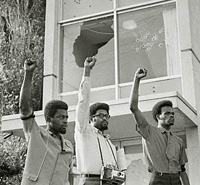
This May I took it upon myself to attend two memorial
observances, the 45th anniversaries of the massacres at Kent State
and Jackson State.
On May 4, 1970, four students were gunned down by the Ohio National Guard at
Kent State University as part of a massive upsurge against the war and for
social change that was sweeping American campuses. Ten days later on May 14,
Mississippi state troopers and Jackson police opened fire on a student protest
at Jackson State, killing two young men, James Earl Green and Phillip Gibbs, in
a massive fusillade. These two shootings were critical points in the events of
May ’70, the most massive and militant nation-wide student strike this country
has ever seen. (I have written
a series of pieces on May ’70, 19 of them and
counting.)
Here are a few reflections based on what I observed. Please
bear in mind that I had not been back to the battlefield at Kent since 1994, and
this was my first trip to Jackson State.
1. I am goddamn old. I was an adult, a young one, when this
shit happened, and that was going on half a century ago.
Nevertheless, like many who were around then, I am unlikely
to forget these killings before I check out.

2. Amidst numerous moving and inspiring moments, I want to
cite two that struck me particularly. The May 4 Visitors Center at
Kent State, one of the most important victories won there in the long struggle
against forgetting, has as its centerpiece a short film, 9 minutes perhaps,
with many photographs and sound recordings of the deadly moments around the
National Guard firing. I sat through it three times.
If you are ever within, say, a three hour
drive, you should watch it.
At Jackson State, the then-president of the school, Dr. John
A. Peoples, described the aftermath of the shooting. He told how for the next
four years at every sporting event the school’s team played in, Jackson
students greeted the national anthem by standing silently with their fists in
the air, Tommie Smith & John Carlos-style. His pride was evident, as was
his quiet delight when he described sitting next to the governor of Mississippi
at one such game.
3. Kent is an amazing anomaly. For forty-five straight year
people have made hajj to the campus from across the country, joining with a
core of regulars associated with the university and the town of Kent to remember May 4, 1970. I
cannot think of anything comparable in the left movement in this country. In
New York there is an annual memorial for the victims of the Triangle Shirtwaist
Fire. In Bay View, WI, now part of Milwaukee, the local labor movement
remembers the 1886 murder of seven strikers by National Guardsmen at a steel
mill. Both of these events are mainly local in character and both date in their
current form to the revival of labor militancy and interest in the working class
during the '60s and '70s.
Why is Kent so different? The most obvious thing is that it
was white college kids who were shot,
on their campus, by the National Guard. It stunned the country at the time, a
time when hundreds of thousands of us were on strike at our own campuses. This
was reinforced by the classic musical mnemonic, "Ohio" written by Neil Young
and pushed into immediate release by Crosby, Stills, Nash & Young in the
aftermath of the killings.
Further, the university administration did its best to
obliterate all memory of the killings. This led in 1977 to Tent City, erected
to block the construction of a gymnasium on the murder site, and to a decades-long
campaign of militant struggle rejecting further attempts to kill or to coopt
and dilute the memory.
Nowadays, May 4 is observed by several days of talks,
forums, and culture. One I attended was run by young members of Black United
Students, whose powerful panel and heartbreaking stories laid bare how little
has actually changed since their predecessors were organizing and protesting
racism and discrimination at Kent in 1970.
The heart of the observance is memorial rituals now enshrined
by time: a candlelight march as May 3 turns into May 4, this year numbering
335, followed by a vigil in which volunteers take rotating shifts holding candles at
the now-memorialized spots where the four fell. (I stood for Jeffrey Miller and
Sandy Scheuer at different points during the night). It culminates with an
emotional memorial program.
While folks come from around the country to take part, the
commemoration is centered on Kent people. In addition to nationally recognized
spokespeople like my old compa Alan Canfora and Tom Grace, there is a core of
people residing in Kent who do the invisible work that makes it happen. Here I
will single out as representative the folk I stayed with there, Mike Pacifico
and Kendra Hicks Pacifico, whose basement is a well-organized stash of decades
worth of banners, candles and other nuts and bolts of the protest. And the ongoing
student group, the May 4 Task Force, provides not just bodies but leadership.
The whole comprises what old hands call the Kent May 4
Family. And in multiple ways it is a family. First, relatives of the fallen
have been part of it from the start. Most of the parents, active from the start, are now
dead or are unable to attend. Laurel Krause, Alison’s sister, is always a
presence. So is Alan Canfora’s sister, Chick, another Kent alum. Beyond that,
family members of longtime participants who have been brought to Kent since
they were itty-bitties have now come on their own. And new regulars are
adopted, like Canadian photographer Christian Bobak who came to document the
anniversary five years ago and has returned every year since.

4. At Jackson State this year, a short memorial program was
followed by a panel with vigorous participation from veterans of May, 1970 in
the audience. Apparently, annual programs had fallen by the wayside in some
past years but with the rise of the Black Lives Matter movement focused first and
foremost on police killings of young Black men, this year’s program had to
happen.
Where the observation at Kent State University was
overwhelmingly white, the 110 or so at Jackson State were at least that Black.
Participation was even older than at Kent. The two activists in their twenties
who drove me down from Memphis were among the youngest people there, save for a
few in strollers.

The formal program was attended by about blessedly short
given the outdoor heat and lack of shade. Bjorn, one of the Tennesseans I
traveled with, summed it up as highlighting students from 1970 who had gone on to
academic or professional success, and marked by frequent references to the
events of May 15 as “a tragedy.” Jackson’s new Chief of Police, a younger alum,
had to say he knows what people are thinking about police these days and why,
and pledged that there would be no such occurrences on his watch.
Maybe 50 people stayed for the forum after, and folks there were plenty clear.
What happened in May 15, 1970 was not “tragic," it was murder. Murder by the
police. It was fascinating to watch the veterans share their experiences and
try and pull together what they had seen into a larger, more coherent picture
of the deadly assault they had survived. Comparisons to the present murders of
young African-Americans were blunt and frequent. And I wish every white yahoo
who responds to police violence by going on about Black-on-Black violence could
have been there to listen to folks from the community grapple with the problem.
(Both halves of the program were livestreamed by
Jackson State; video can be viewed
here.)
5. LONG LIVE THE SPIRIT OF KENT AND JACKSON STATE! was the
slogan that resonated through the student movement in the 70’s and 80’s. Folks
that were active in 1970 will, to this day, automatically respond to mention of
Kent State by saying “
and Jackson State.” Thus, the struggle for memory,
and against the tendency of the fiercest of people’s battles to be crammed down
the Great American Memory Hole, has also helped keep the memory of the Jackson
killings alive far beyond the borders of the campus itself.
Activists in the May 4 movement at Kent have
always worked to maintain ties with Jackson State. For years until his untimely
death earlier this decade, Gene Young represented Jackson at Kent State every
year and was a cherished figure in the community there.
Still, the greater attention to Kent in memory and in history as it is taught
and written in this white supremacist country is obvious. It clearly rankles
many of the veterans at Jackson State. Several made a point of complaining that
the protest at Jackson is too often described as an anti-war protest and not primarily
as a protest against the multi-faceted racism directed at Black students in the
capital of Mississippi in 1970.
6. It is only natural that the focus on Kent (and, always, Jackson)
in the May 4 commemorations carries with it a certain built-in narrowness.
While the killings at Kent kicked the national student strike into overdrive,
it was already the largest and most powerful student protest in the history of
the country.
The thing about Kent is that the administration closed the
campus up tight on the afternoon of May 4 and ordered everyone to leave. From
the standpoint of Kent, the May '70 story pretty much ends here, but those of
us who were around during that fateful month know this was only part of the
story. The truncation of the narrative can be seen clearly in the May 4
Visitor’s Center. The Kent-centrism is reflected in the three parts of the
museum. The build-up section presents a broad picture of the 60’s and the
tectonic shifts in politics, society and culture that that gave rise to the
earthquake that was May 1970. The central section is the film about the events
of that day. The third part is heavily focused on various responses to the Kent
killings, with some attention to Jackson State.
The fact that the movement went on to greater heights, more
militant battles, and striking accomplishments is absent. I spoke with two paid
staffers, neither of whom knew about the police killings of six young Black men
in Augusta, Georgia between the shootings in Kent and Jackson, or about the
“hard hat riots,” savage attacks on protestors by union construction workers,
organized in conjunction with President Nixon’s White House.
This is baked into the long struggle at Kent and it is not
the particular responsibility of activists there to correct it. That falls
rather to veterans of all the battles of May 1970: step up, dredge up the
memories and spread the lessons, as folks have been doing at Kent and Jackson
all these years.
7. There were some intriguing parallels at the
two events.
Both sets of May 1970 veterans emphasized the organized nature of the murderous
attacks—at Kent, the National Guard unit wheeling, kneeling and firing in
unison into the unarmed students, and at Jackson the way the po-po marched in
order up Lynch Street before turning to fire on the students.
Similarly, some people at both campuses seem driven to deny
that the burning of the ROTC buildings there were the work of campus protesters.
At Kent, the conspiracy-minded attribute not only the May 2 fire but also the
cutting of firehoses to prevent it being extinguished to the work of provocateurs
directed by the feds. At Jackson, the tendency is to blame vandalism by “the corner
boys,” young Black men who hung out in the neighborhood of the campus. Well,
maybe. But let’s not forget that 30 ROTC buildings developed problems which
compromised their structural integrity, shall we say, during the first week of
May 1970. Thirty. I know for a fact that some were not the work of provocateurs
or “outside elements.”
We have two books to look forward to, both headed for
publication. Tom Grace, wounded on May 4 and now a professor in Buffalo, will add
his analysis to the considerable body of works on Kent State. The absence of a
comparable shelf full of books dealing with Jackson State is to be improved by
Dr. Nancy Bristow of the University of Puget Sound, who is finalizing a definitive
study.
Best of all is a little script flip. At Jackson State, a
white prof, Dr. Robert Luckett of the History Department, evidently played an
important role in organizing the program. At Kent the faculty adviser of the student
May 4 Task Force for more than a decade is a lecturer in the Department of
Pan-African Studies, Idris Kabir Syed, who also acts as adviser to Black United
Students there. Sweet, hunh?
8. Finally, I want to issue a challenge to the Kent State
May 4 Family and to others, old school veterans and new activists alike, who
hold the memory of the events of May ’70 in their hearts. A Venn diagram of the
attendees at the Kent and Jackson observations this year would show the circles
intersecting at one point. Me. That ain’t right. If there is a 46th
anniversary celebration at Jackson State next year, I hope you will join me
there.
Read more!