
[A few days ago, Fire on the Mountain published an incensed and incisive response by Puerto Rican Marxist SKS to an article on the Occupy! movement by Chris Hedges calling the Black Bloc and militant resistance more generally "a cancer in Occupy." As the debate on this has not yet died down, FotM is pleased to post another response to Hedges, this one by an anarchist, David Graeber, who gave permission to borrow it from the blog n+1, where it originally appeared.]
In response to “The Cancer in Occupy,” by Chris Hedges.
by David Graeber
I am writing this on the premise that you are a well-meaning person who wishes Occupy Wall Street to succeed. I am also writing as someone who was deeply involved in the early stages of planning Occupy in New York.
I am also an anarchist who has participated in many Black Blocs. While I have never personally engaged in acts of property destruction, I have on more than one occasion taken part in Blocs where property damage has occurred. (I have taken part in even more Blocs that did not engage in such tactics. It is a common fallacy that this is what Black Blocs are all about. It isn’t.)
I was hardly the only Black Bloc veteran who took part in planning the initial strategy for Occupy Wall Street. In fact, anarchists like myself were the real core of the group that came up with the idea of occupying Zuccotti Park, the “99%” slogan, the General Assembly process, and, in fact, who collectively decided that we would adopt a strategy of Gandhian non-violence and eschew acts of property damage. Many of us had taken part in Black Blocs. We just didn’t feel that was an appropriate tactic for the situation we were in.
This is why I feel compelled to respond to your statement “The Cancer in Occupy.” This statement is not only factually inaccurate, it is quite literally dangerous. This is the sort of misinformation that really can get people killed. In fact, it is far more likely to do so, in my estimation, than anything done by any black-clad teenager throwing rocks.
Let me just lay out a few initial facts:
1. Black Bloc is a tactic, not a group. It is a tactic where activists don masks and black clothing (originally leather jackets in Germany, later, hoodies in America), as a gesture of anonymity, solidarity, and to indicate to others that they are prepared, if the situation calls for it, for militant action. The very nature of the tactic belies the accusation that they are trying to hijack a movement and endanger others. One of the ideas of having a Black Bloc is that everyone who comes to a protest should know where the people likely to engage in militant action are, and thus easily be able to avoid it if that’s what they wish to do.
2. Black Blocs do not represent any specific ideological, or for that matter anti-ideological position. Black Blocs have tended in the past to be made up primarily of anarchists but most contain participants whose politics vary from Maoism to Social Democracy. They are not united by ideology, or lack of ideology, but merely a common feeling that creating a bloc of people with explicitly revolutionary politics and ready to confront the forces of the order through more militant tactics if required, is, on the particular occasion when they assemble, a useful thing to do. It follows one can no more speak of “Black Bloc Anarchists,” as a group with an identifiable ideology, than one can speak of “Sign-Carrying Anarchists” or “Mic-Checking Anarchists.”
3. Even if you must select a tiny, ultra-radical minority within the Black Bloc and pretend their views are representative of anyone who ever put on a hoodie, you could at least be up-to-date about it. It was back in 1999 that people used to pretend “the Black Bloc” was made up of nihilistic primitivist followers of John Zerzan opposed to all forms of organization. Nowadays, the preferred approach is to pretend “the Black Bloc” is made up of nihilistic insurrectionary followers of The Invisible Committee, opposed to all forms of organization. Both are absurd slurs. Yours is also 12 years out of date.
4. Your comment about Black Bloc’ers hating the Zapatistas is one of the weirdest I’ve ever seen. Sure, if you dig around, you can find someone saying almost anything. But I’m guessing that, despite the ideological diversity, if you took a poll of participants in the average Black Bloc and asked what political movement in the world inspired them the most, the EZLN would get about 80% of the vote. In fact I’d be willing to wager that at least a third of participants in the average Black Bloc are wearing or carrying at least one item of Zapatista paraphernalia. (Have you ever actually talked to someone who has taken part in a Black Bloc? Or just to people who dislike them?)
5. “Diversity of tactics” is not a “Black Bloc” idea. The original GA in Tompkins Square Park that planned the original occupation, if I remember, adopted the principle of diversity of tactics (at least it was discussed in a very approving fashion), at the same time as we all also concurred that a Gandhian approach would be the best way to go. This is not a contradiction: “diversity of tactics” means leaving such matters up to individual conscience, rather than imposing a code on anyone. Partly,this is because imposing such a code invariably backfires. In practice, it means some groups break off in indignation and do even more militant things than they would have otherwise, without coordinating with anyone else—as happened, for instance, in Seattle. The results are usually disastrous. After the fiasco of Seattle, of watching some activists actively turning others over to the police—we quickly decided we needed to ensure this never happened again. What we found that if we declared “we shall all be in solidarity with one another. We will not turn in fellow protesters to the police. We will treat you as brothers and sisters. But we expect you to do the same to us”—then, those who might be disposed to more militant tactics will act in solidarity as well, either by not engaging in militant actions at all for fear they will endanger others (as in many later Global Justice Actions, where Black Blocs merely helped protect the lockdowns, or in Zuccotti Park, where mostly people didn’t bloc up at all) or doing so in ways that run the least risk of endangering fellow activists.
All this is secondary. Mainly I am writing as an appeal to conscience. Your conscience, since clearly you are a sincere and well-meaning person who wishes this movement to succeed. I beg you: Please consider what I am saying. Please bear in mind as I say this that I am not a crazy nihilist, but a reasonable person who is one (if just one) of the original authors of the Gandhian strategy OWS adopted—as well as a student of social movements, who has spent many years both participating in such movements, and trying to understand their history and dynamics.
I am appealing to you because I really do believe the kind of statement you made is profoundly dangerous.
The reason I say this is because, whatever your intentions, it is very hard to read your statement as anything but an appeal to violence. After all, what are you basically saying about what you call “Black Bloc anarchists”?
1) they are not part of us
2) they are consciously malevolent in their intentions
3) they are violent
4) they cannot be reasoned with
5) they are all the same
6) they wish to destroy us
7) they are a cancer that must be excised
Surely you must recognize, when it’s laid out in this fashion, that this is precisely the sort of language and argument that, historically, has been invoked by those encouraging one group of people to physically attack, ethnically cleanse, or exterminate another—in fact, the sort of language and argument that is almost never invoked in any other circumstance. After all, if a group is made up exclusively of violent fanatics who cannot be reasoned with, intent on our destruction, what else can we really do? This is the language of violence in its purest form. Far more than “fuck the police.” To see this kind of language employed by someone who claims to be speaking in the name of non-violence is genuinely extraordinary. I recognize that you’ve managed to find certain peculiar fringe elements in anarchism saying some pretty extreme things, it’s not hard to do, especially since such people are much easier to find on the internet than in real life, but it would be difficult to come up with any “Black Bloc anarchist” making a statement as extreme as this.
Even if you did not intend this statement as a call to violence, which I suspect you did not, how can you honestly believe that many will not read it as such?
In my experience, when I point this sort of thing out, the first reaction I normally get from pacifists is along the lines of “what are you talking about? Of course I’m not in favor of attacking anyone! I am non-violent! I am merely calling for non-violently confronting such elements and excluding them from the group!” The problem is that in practice this is almost never what actually happens. Time after time, what it has actually meant in practice is either a) turning fellow activists over to the police, i.e., turning them over to people with weapons who will physically assault, shackle, and imprison them, or b) actual physical activist-on-activist assault. Such things have happened. There have been physical assaults by activists on other activists, and, to my knowledge, they have never been perpetrated by anyone in Black Bloc, but invariably by purported pacifists against those who dare to pull a hood over their heads or a bandana over their faces, or, simply, against anarchists who adopt tactics someone else thinks are going too far. (Not I should note even potentially violent tactics. During one 15-minute period in Occupy Austin, I was threatened first with arrest, then with assault, by fellow campers because I was expressing verbal solidarity with, and then standing in passive resistance beside, a small group of anarchists who were raising what was considered to be an unauthorized tent.)
This situation often produces extraordinary ironies. In Seattle, the only incidents of actual physical assault by protesters on other individuals were not attacks on the police, since these did not occur at all, but attacks by “pacifists” on Black Bloc’ers engaged in acts of property damage. Since the Black Bloc’ers had collectively agreed on a strict policy of non-violence (which they defined as never doing anything to harm another living being), they uniformly refused to strike back. In many recent occupations, self-appointed “Peace Police” have manhandled activists who showed up to marches in black clothing and hoodies, ripped their masks off, shoved and kicked them: always, without the victims themselves having engaged in any act of violence, always, with the victims refusing, on moral grounds, to shove or kick back.
The kind of rhetoric you are engaging in, if it disseminates widely, will ensure this kind of violence becomes much, much more severe.
Perhaps you do not believe me, or do not believe these events to be particularly significant. If so, let me put the matter in a larger historical context.
If I understand your argument, it seems to come down to this:
1. OWS has been successful because it has followed a Gandhian strategy of showing how, even in the face of strictly non-violent opposition, the state will respond with illegal violence
2. Black Bloc elements who do not act according to principles of Gandhian non-violence are destroying the movement because they provide retroactive justification for state repression, especially in the eyes of the media
3. Therefore, the Black Bloc elements must be somehow rooted out.
As one of the authors of the original Gandhian strategy, I can recall how well aware we were, when we framed this strategy, that we were taking an enormous risk. Gandhian strategies have not historically worked in the US; in fact, they haven’t really worked on a mass scale since the civil rights movement. This is because the US media is simply constitutionally incapable of reporting acts of police repression as “violence.” (One reason the civil rights movement was an exception is so many Americans at the time didn’t view the Deep South as part of the same country.) Many of the young men and women who formed the famous Black Bloc in Seattle were in fact eco-activists who had been involved in tree-sits and forest defense lock-downs that operated on purely Gandhian principles—only to find that in the US of the 1990s, non-violent protesters could be brutalized, tortured (have pepper spray directly rubbed in their eyes), or even killed, without serious objection from the national media. So they turned to other tactics. We knew all this. We decided it was worth the risk.
However, we are also aware that when the repression begins, some will break ranks and respond with greater militancy. Even if this doesn’t happen in a systematic and organized fashion, some violent acts will take place. You write that Black Bloc’ers smashed up a “locally owned coffee shop”; I doubted this when I read it, since most Black Blocs agree on a strict policy of not damaging owner-operated enterprises, and I now find in Susie Cagle’s response to your article that, in fact, it was a chain coffee shop, and the property destruction was carried out by someone not in black. But still, you’re right: A few such incidents will inevitably occur.
The question is how one responds.
If the police decide to attack a group of protesters, they will claim to have been provoked, and the media will repeat whatever the police say, no matter how implausible, as the basic initial facts of what happened. This will happen whether or not anyone at the protest does anything that can be remotely described as violence. Many police claims will be obviously ridiculous – as at the recent Oakland march where police accused participants of throwing “improvised explosive devices”—but no matter how many times the police lie about such matters, the national media will still report their claims as true, and it will be up to protesters to provide evidence to the contrary. Sometimes, with the help of social media, we can demonstrate that particular police attacks were absolutely unjustified, as with the famous Tony Bologna pepper-spray incident. But we cannot by definition prove all police attacks were unjustified, even all attacks at one particular march; it’s simply physically impossible to film every thing that happens from every possible angle all the time. Therefore we can expect that whatever we do, the media will dutifully report “protesters engaged in clashes with police” rather than “police attacked non-violent protesters.” What’s more, when someone does throw back a tear-gas canister, or toss a bottle, or even spray-paint something, we can assume that act will be employed as retroactive justification for whatever police violence occurred before the act took place.
All this will be true whether or not a Black Bloc is present.
If the moral question is “is it defensible to threaten physical harm against those who do no direct harm to others,” one might say the pragmatic, tactical question is, “even if it were somehow possible to create a Peace Police capable of preventing any act that could even be interpreted as ‘violent’ by the corporate media, by anyone at or near a protest, no matter what the provocation, would it have any meaningful effect?” That is, would it create a situation where the police would feel they couldn’t use arbitrary force against non-violent protesters? The example of Zuccotti Park, where we achieved pretty consistent non-violence, suggests this is profoundly unlikely. And perhaps most importantly at all, even if it were somehow possible to create some kind of Peace Police that would prevent anyone under gas attack from so much as tossing a bottle, so that we could justly claim that no one had done anything to warrant the sort of attack that police have routinely brought, would the marginally better media coverage we would thus obtain really be worth the cost in freedom and democracy that would inevitably follow from creating such an internal police force to begin with?
These are not hypothetical questions. Every major movement of mass non-violent civil disobedience has had to grapple with them in one form or another. How inclusive should you be with those who have different ideas about what tactics are appropriate? What do you do about those who go beyond what most people consider acceptable limits? What do you do when the government and its media allies hold up their actions as justification—even retroactive justification—for violent and repressive acts?
Successful movements have understood that it’s absolutely essential not to fall into the trap set out by the authorities and spend one’s time condemning and attempting to police other activists. One makes one’s own principles clear. One expresses what solidarity one can with others who share the same struggle, and if one cannot, tries one’s best to ignore or avoid them, but above all, one keeps the focus on the actual source of violence, without doing or saying anything that might seem to justify that violence because of tactical disagreements you have with fellow activists.
I remember my surprise and amusement, the first time I met activists from the April 6 Youth Movement from Egypt, when the issue of non-violence came up. “Of course we were non-violent,” said one of the original organizers, a young man of liberal politics who actually worked at a bank. “No one ever used firearms, or anything like that. We never did anything more militant than throwing rocks!”
Here was a man who understood what it takes to win a non-violent revolution! He knew that if the police start aiming tear-gas canisters directly at people’s heads, beating them with truncheons, arresting and torturing people, and you have thousands of protesters, then some of them will fight back. There’s no way to absolutely prevent this. The appropriate response is to keep reminding everyone of the violence of the state authorities, and never, ever, start writing long denunciations of fellow activists, claiming they are part of an insane fanatic malevolent cabal. (Even though I am quite sure that if a hypothetical Egyptian activist had wanted to make a case that, say, violent Salafis, or even Trotskyists, were trying to subvert the revolution, and adopted standards of evidence as broad as yours, looking around for inflammatory statements wherever they could find them and pretending they were typical of everyone who threw a rock, they could easily have made a case.) This is why most of us are aware that Mubarak’s regime attacked non-violent protesters, and are not aware that many responded by throwing rocks.
Egyptian activists, in other words, understood what playing into the hands of the police really means.
Actually, why limit ourselves to Egypt? Since we are talking about Gandhian tactics here, why not consider the case of Gandhi himself? He had to deal with what to say about people who went much further than rock-throwing (even though Egyptians throwing rocks at police were already going much further than any US Black Bloc has). Gandhi was part of a very broad anti-colonial movement that included elements that actually were using firearms, in fact, elements engaged in outright terrorism. He first began to frame his own strategy of mass non-violent civil resistance in response to a debate over the act of an Indian nationalist who walked into the office of a British official and shot him five times in the face, killing him instantly. Gandhi made it clear that while he was opposed to murder under any circumstances, he also refused to denounce the murderer. This was a man who was trying to do the right thing, to act against an historical injustice, but did it in the wrong way because he was “drunk with a mad idea.”
Over the course of the next 40 years, Gandhi and his movement were regularly denounced in the media, just as non-violent anarchists are also always denounced in the media (and I might remark here that while not an anarchist himself, Gandhi was strongly influenced by anarchists like Kropotkin and Tolstoy), as a mere front for more violent, terroristic elements, with whom he was said to be secretly collaborating. He was regularly challenged to prove his non-violent credentials by assisting the authorities in suppressing such elements. Here Gandhi remained resolute. It is always morally superior, he insisted, to oppose injustice through non-violent means than through violent means. However, to oppose injustice through violent means is still morally superior to not doing anything to oppose injustice at all.
And Gandhi was talking about people who were blowing up trains, or assassinating government officials. Not damaging windows or spray-painting rude things about the police.
February 17, 2012
Concerning the Violent Peace-Police: An Open Letter to Chris Hedges


February 10, 2012
The Psychopathology of a Liberal OWS! Baiter
[Since Chris Hedges, a columnist at the website truthdig published the provocatively titled, "The Cancer in Occupy" four days ago, there has been boocoo Internet debate and some vigorous responses, for example, this one at Counterpunch. Occasional Fire on the Mountain essayist SKS, who wrote a widely read piece on this blog on the problems of infiltration and provocateurs in OWS!, posted this angry reply to Hedges on Facebook. FotM republishes it with his permission to help it get the wider circulation it deserves.]
The Stockholm Syndrome of Occupy:
Chronicle of a Death Foretold
by SKS
I do not want to repeat what many have said, more eloquently or timely. Any repetition will either be unconscious or inevitable--but I do try to bring some fresh perspectives, or at least accents. So bear with me.
Ever since the Oakland Commune came into national consciousness with their successful strike in November, liberals who initially became infatuated with Occupy Wall Street! as a possible liberal Tea Party have been launching increasingly virulent attacks against OWS!, and in particular, its most militant element.
Naomi Wolf launched perhaps the first notorious salvo of the liberal commentariat, when, going all in with her arrest cred, she called OWS! protesters against NBC (a corporation) "fascists".
While debate is healthy, and diversity of opinions and views is both inevitable and one of the refreshing things of OWS! as a movement, the interventions from the liberal camp have been increasingly totalitarian, undemocratic, and full of factual and historical inaccuracies.
They have moved from honest, concerned, disagreement within the movement, to dishonest hit pieces worthy of the worse dirty politics.
And this is something we predicted: we knew that the primary contradiction within this movement would be the need of liberals and the Democratic Party machine to turn this movement into a huge astroturf project to counter the successful co-optation by the Republicans of the Tea Party--of huge importance if Obama is to be re-elected.
This has been done with a carrot and stick approach. The carrot has been the apparently open arms of labor unions and non-profit organizations, not to mention several elected officials of the Democratic Party.
The stick has two sides: one is represented by poster child of all-that-is-wrong-with-the-Democrats, Oakland Mayor Jean Quan and her Swine Corps of the brutal and brutalizing Oakland Police Department--an OPD she ran on an unfulfilled promise to reform and transform.In fact, it is in Democratic cities were the police repression and police action have been the strongest--Chicago even took the opportunity to institute surveillance and free-speech limitation ordinances worthy of 1984. Of course, aside from a few feeble protests from the ACLU, this largely has happened with the silent consent of the liberal commentariat, and when not silence, with ineffective chatter coupled with "critical" support for the elected officials promoting these things.
The other side of the stick is the concerted effort of the liberal commentariat. At first rather benign, starting with the mantra--a sheer lie--that the movement had no goals, and with disingenuous criticism of liberal We foretold this: even at the very earliest most committed Occupy! activists knew this was coming.
We did not know how, but we had an idea, which is why we refused giving these commentators special status in the movement--we knew instinctively that they would turn on us come 2012 and the presidential election. Now it is upon us. Chronicle of a death foretold. None of this should come as a surprise, but buyer beware: you might think you agree--after all, the black bloc can be insufferably cocky and elitist, but you do not. Your legitimate tactical concern and strategic considerations are quite different from Chris Hedges'.
Pathologizing the Other: what abusers and repressive regimes can tell us about Chris Hedges
Nazis knew the value of pathology in politics.
As a large body of literature demonstrates, repressive regimes throughout history have used this very technique to throw political opponents into jails called "mental hospitals". Abusers--be they bullies or domestic--routinely try to smash the self-esteem of their victims by questioning their mental health. "You are crazy" is a favorite phrase of the abusive spouse or partner, of the abusive boss, of the abusive authority figure. Fear of being labeled "crazy" is in fact one of the most powerful ways of social coercion and social discipline know. Even good parents tell their kids they are being "crazy" when they do things they are not supposed to do.
Chris Hedges, in his hit piece, does several things of this sort: first he pathologizes "violence"--using prose worthy of a pulp novel with Fabio on the cover, the kind they sell in supermarket checkout lines. Then he claims the black bloc is "hypermasculine"--a ridiculous term pulled out of the same kindergarden infantislism that gives you a whole range of funny, yet unnecesary, superlatives. Without getting into this rather old and extensive debate, many feminist voices have eloquently countered the presumption--gendered and sexist in itself--that violence has a gender, let's just say that this confuses an important discussion on tactics with an ad hominem intended not to discuss, but to rally the liberal troops for an attack. In other words, exactly what he describes as "hypermasculinity".
Unlike Hedges, I do not have a romantic, nihilist violent self buried inside. My views on violence are rather conscious--do not initiate aggression, but defend yourself from it. This basic human instinct seems beneath the elevated Hedges, whose superior god-like peace elevates him above us mere mortals.His god-like powers allow him to bury his violent instincts deep in his psyche.
(See what I mean about pulp prose?)
In pathologizing the political, Hedges is re-establishing the patriarchal and racial supremacy of white male hetero-normativity: those who disagree with him are not normal like him, they are crazy, they must be excluded from normal society.
He is calling out his wayward children, like all good patriarchs do. Very hypermasculine.
Interestingly, his pathologizing doesn't stop at mental health. It gets even worse.
As the title "Cancer of Occupy" explicitly tells us, the crazy children are not just crazy, they are a cancer.
Well, the use of "cancer"--and other body diseases--in political speech has a rather interesting origin that Chris Hedges either overlooked, or consciously deployed: Nazi eugenics and racial hygiene. "Jewish bacillus," "the Bolshevist poison," "the Jewish plague," "the Jewish parasites," and the "Jewish cancer.
These are the ripped from the headlines terms of Hitler and the Nazi propaganda machine. Unlike Naomi Wolf, I only call fascists those who are actually fascist--I do not cheapen the word by using it to attack everyone that irks me--but it is indeed telling about the way Chris Hedges' mind works that he chose this term.
What is the cure for cancer? Chemotherapy, radiation, extirpation, all which are extremely violent--and much less successful than what we would like them to be.
So Chris Hedges implies--in contradiction with his argument--that this cancer must be cured. He leaves the question open--but the emotional response in the reader, and this is by choice, is to respond as we all do: kill it with violence. No one loves cancer. No one thinks of the feelings of cancer. You try to kill it, or it kills you.
That is one from the Nazi playbook: it's how a whole country was mobilized to destroy the "Jewish cancer". Hitler did not need to order them what to do. We all know, intuitively, what to do with cancer. Hedges joins a proud tradition.
(Ironically, in the channer culture that gave birth to Anonymous "cancer" is also used to describe newbies to the culture--and if there is a hypermasculine place in the world, it is channer culture--Hedges does have a lot of self-hating to do.)
And it is ironic, too, that in purporting to be part of this movement, Hedges has no article calling the Democrats cancer. After all, the black blocs have yet to kill someone, but the Democrats have killed millions--often at the push of a button.
So let's pathologize--just to not combo break!
That brings me to my title. A little flair of my own pathologization. In my defense, it is the game field Hedges presents.
So why Stockholm Syndrome? Well, as you might know, this syndrome is the apparently paradoxical psychological phenomenon in which hostages express empathy and have positive feelings towards their captors, sometimes to the point of defending them*.
A lot of the response to so-called "black bloc violence" smacks precisely of this phenomenon. Chris Hedges is either a victim of this syndrome, or an enabler of its suffering.
He makes a storm in a teapot on so-called "black bloc violence"--justifying the violence of the OPD, of the State, of our captors--of the very State and repressive forces of the dictatorship of the 1%. He is not one of them, yet defends them and justifies and covers their crimes.
A few broken windows are nothing compared to the hundred of extrajudicial killings on the part of police, or dozens of executions, not to mention overseas.
Let's have a sense of proportion. Let's break out of the Stockholm Syndrome. The violence that matters, the true violence, is that of the State, not the black bloc. We do not need to be uncritical of the black bloc--but to hide behind their actions to call for inaction when much greater crimes are being committed, on a daily basis and using your tax money, is to cower in fear in front of power.
Just like a hostage in front of his or her captor.
We are hostages to the 1%. Do we justify them or do we fight for freedom?
Violence, non-violence, and disingenuousness
Are we the 99% or are we Democrats?
For liberals of the Naomi Wolf and Chris Hedges brand, revolutions are something that happens elsewhere. Regimes that need changes are overseas--preferably in countries with long histories of "authoritarian regimes". In their twisted worldview--and one that gets fed to us as somehow radical--what problems exist in the USA can be resolved in the framework of civil liberties provided by the Constitution, the institutions being neutral servants of the common good. Such lofty ideals fly in the face of the actual realities of life in the USA, in particular for the 99%. The USA has, for example, one of the highest rates of extra-judicial killing and death penalty in the world.
A significant percentage of this country's population express support for this appalling situation. So did, for that matter, a significant percentage of Egypt's population before the Revolution threw the doors open to true dissent, rather than fear. Transformation is about critical masses, not simple majorities.
We cannot be both for regime change and for the Democrats, who are part of the regime.
The Democrats' main funder is, consistently, Goldman Sachs--one of the worse criminal gangs of the 1%.
In Chris Hedges' view, Goldman Sachs is an upstanding citizen that makes mistakes, a person worthy of our democratic respect. The black bloc is cancer.
He serves his masters well.
Curiously, the way that he speaks of violence vs non-violence echoes the same way that the current regime in Egypt speaks of the Revolution--and we see this world-wide: the "good" protester versus the "bad" protester. Even in Syria, there is the opposition that meets with the Regime, and there is the Free Syrian Army. It is not a new argument.
Now, I also have a sense of proportion--we are far from living in a situation where we need a Free America Army. But the black bloc is not that. Its worst violence is a few broken windows--if that.
To begin with, there is much conflation here: the black bloc is not responsible for all the so-called vandalism or violence. The poster child for the liberals, the Whole Foods vandalization in Oakland, was by all accounts the work of a few individuals against which even black bloc members intervened.
The black bloc however, has been responsible for successful evasion, even de-arrest, of activists - of protective, defensive, non-violent tactics, such as the use of shields, the lighting of bonfires (which clears tear gas quickly), and providing first aid and medevac. They have intervened against sexual and criminal predators in Occupations, serving as stalwarts of discipline in a chaotic environment. This is the reality of those of us who actually are the boots in the ground. Yes, there is much to be critical of in them--but let's leave that for another time: much better commentary is floating around in this respect. They are not cancer--they are part of the body that is maturing, and causes growing pains.
So why the fuzz?
There seems to be a problem of definition in which non-violence is equated with non-resistance. This flies in the face even of Gandhi's and Dr. King's tactics: non-violent resistance is still resistance. It is non-compliance with orders from the powers that be. "We shall not be moved". All those water cannon that Dr. King endured were a result of his movement's steadfast refusal to obey orders from above--to force change.
We can agree that throwing a rock at someone is violent. But is throwing a paint bomb (which obscures police visors) violent? Are shields and grenade nets violent? I do not think so. They are forms of non-violent resistance, practiced by the black bloc--that protect the movement from the inevitable onslaught of the police.
This is not trivial: I understand the need to be non-violent as a tactic, but when non-violence gets reduced to picketing in circles in a "free speech zone," there is no resistance--we are not following Gandhi or Dr. King, we are following the instructions of the regime. No regime has fallen when people obey it. They only fall when people cease to obey it.
Hedges and co-commentators miss this point. Entirely. They equate any resistance with violence.
And without resistance, how can we Occupy? It says it right there in the name!
Diversity of Tactics and Unity of Strategies
What will kill OWS! is not violence, but the people who want to have meetings and voting drives instead of actions of resistance, occupations, and protests. Do not get me wrong, we need meetings--but with a purpose. As for voting, I voted for Obama and all I got was a lousy t-shirt, which I had to pay for.
With protests and occupations, with masses of people out in the street, will come repression. And on the edges, some will want to fight back by means we might not agree with.
It's worth the price, no matter what the anti-resistance commentariat tells us. That is the lesson of Tahrir Square.
It's time we stop lying to ourselves, and realize that this regime--regardless of what party is in power--is repressive regime, based on war profiteering, a racist prison-industrial complex, extrajudicial violence, and destroying the ability of people to achieve their dreams by concentrating wealth and power on the 1%. Dictatorships do not fall on their own.
We live in the dictatorship of the 1%. The time for regime change is long overdue.
That is the stark reality that faces us. If, for you, a few broken windows are too much to oppose the regime, then it means that for you, windows are more important than the millions who have their lives destroyed and extinguished by this regime--in the ghettos, in the prison-industrial complex, overseas, and in the soul-killing petty dictatorship of the workplace.
We need to have real solidarity--the more militant of us need to consider that not everyone is willing or able to, emotionally and physically, to deal with the outcomes of militancy. Those who advocate non-violence out of true principle, need to understand that the deep emotional commitment this requires, while noble, is not for all.
Honest diversity of tactics is a strength, not a weakness.
But we need to be united on the strategic goal of regime change--of transforming the dictatorship of the 1%. And there are those, Chris Hedges and his ilk, who hide behind the language of non-violence to bamboozle and split the movement: he is pretty happy supporting a government that breeds war--while he can speak against it and sue it in court, supporting real violence perpetrated by this regime. He remains silent as police murder people extrajudicially--the very real violence of the State.
What is worse, as argued, he uses the age old tactic of abusers and repressive regimes throughout history: he pathologizes those he disagrees with, calling into question their mental health and treating them as a public health issue that needs a hygienic response--in the tone of the Nazi racial hygiene. Chris Hedges and his ilk, defend the regime in deeds and words--they are at best a loyal opposition content with commenting rather than transforming. Do not join them.
Join the resistance: the path is long, the path is painful, but the path is righteous.
Refuse and resist!
July 9, 2010
Oakland Says Guilty! Justice For Oscar Grant!

[The verdict on killer cop Johannes Mehserle is in. An all-white jury in Los Angeles has determined that the act of shooting year-old Oscar Grant in the back while he lay handcuffed and face down on the Oakland BART station platform constituted involuntary manslaughter (an “oopsie” verdict which will give him a maximum of 4 years in the slams). As the verdict approached, Oakland had tensed for a re-run of the rebellion which ripped there after the killing.
An old friend did a 
By the time I got there late (7:30 pm), the crowd had thinned to 800. Not sure how much more it had been. I expected larger . I think the police buildup and pre-verdict hype I wrote about last week had some, perhaps many, scared. Many of my son's friends (high school age) were told they couldn't go for fear of the violence.
The rally was still on with some speakers, mainly those who walked up to the mike and wanted to say something--the big names musta come and gone before.
I heard Jabari Shaw, president of the Black Student Union at Laney College in Oakland, complement the multi-racial make up of the crowd and declare that we must focus our anger on change to go beyond venting our anger on the businesses in the area, that we need to change the whole damn system.
Bobby Hutton's niece spoke! (Bobby Hutton, or "Lil' Bobby," was the youngest member of the Black Panther Party. He joined soon after the conception of the BPP in 1966 at the age of 16. On April 6, 1968, he was killed by Oakland Police after a firefight. According to witnesses, police shot him more than a dozen times after he had surrendered and had stripped down to his underwear to prove that he was unarmed.)
She talked of the services that the Black Panthers provided, free breakfast programs and daycare for the kids. She said that these services are still needed in our community now, that people are still hungry, but that the BPP had been decimated by the police. And concluded that this legacy of African Americans being murdered by cops was nothing new.
The rally officially ended shortly after 8pm. Many of those left milled around, some moved to an adjacent intersection. Police presence was incredibly large with all streets leading from the intersections cordoned off by police from various jurisdictions--CHP, Hayward, Berkeley, Fremont, Alameda, Oakland, to name a few that I heard of. Reports from people driving on the freeways between 4pm and 5pm were that large convoys of police cars, including armored vehicles of some sorts, went whizzing past everyone, lights blazing. Some of these reportedly had 20 or more vehicles in a group.
Some bottles and cans were thrown towards a line of police. This sent many in the crowd running away, jittery from the pre-verdict, riot-that-will-be-Oakland hype I wrote to you about last week. Some windows were broken, which soon had more in the crowd leaving the area. Police at that point were putting on gas masks and letting people leave the cordoned-off section of downtown but not enter.
At one point about 20 CHP cars came screeching into the area, lights and sirens blazing.The CHP had criss-crossed their side windows with duct tape, presumably to prevent them from being broken.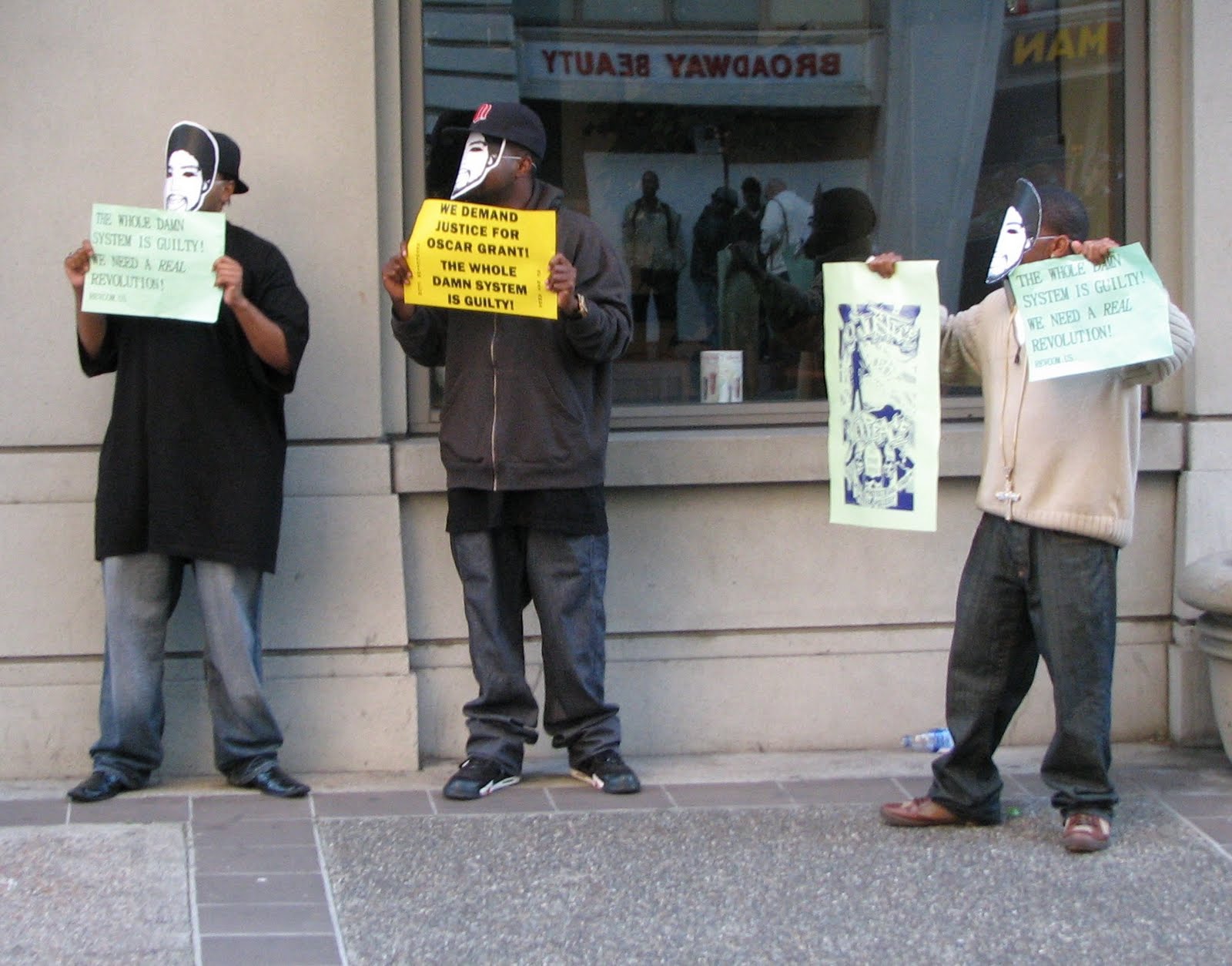
The crowd by now was getting down to 150 or so, I would estimate. Many wore bandanas over their faces, or Oscar Grant masks.
... At this point I took my boys and myself out of the area. The noose was being tightened and I didn’t have bail money for all of us :)
This Just In:
Taping side windows does not protect windshields!
March 5, 2010
March 4: The Tide Is Rising--A First-Hand Report
Perhaps the most important single protest of the Obama era so far took place yesterday--the national day of action in defense of public education. Despite the huge differences in specifics from pre-K to grad school and from state to state, there were hundreds of protests around the country in response to an initial call, from Cali, the epicenter of the current wave of struggle.
These battles are the most widespread organized resistance to tuition hikes, savage cutbacks and privatization initiatives, all fueled by the economic meltdown. Somehow the "green shoots" the administration and media so like to talk about appear to be unable to push up through the mountainous state and local budget deficits and education is one of the first targets.
Although there's a lot of day after reportage, the build-up took place largely under the media's radar, despite endorsements from the likes of the national AFL-CIO. One noteworthy occurrence suggests real concern and divisions in the ruling clas--that's the feature article published March 3, the day before the protest, in the NY Times, on rebarbative "education reform expert" Diane Ravitch, who is now recanting the pro-privatization, pro-charter school, pro-standardized testing views she had spent decades pushing. Clearly some realize that a total collapse of the US educational system is not in the interests of the ruling class.
Anyhow, I want to get to cases. Here is a inspiring and moving summation of some of what happened in Berkeley, just sent me by Liz, a 'rade of mine who is in grad school there.
What I saw yesterday at UC Berkeley looked like "movement" because so many different kinds of people were moving in sync: anarchists who want to shut it down and occupy; students who want to lobby in Sacramento; laid off high-school teachers who want to teach; Asian and Pacific Island students demanding the right to education for immigrants; custodians who want to send their own kids college; 10 year-olds chanting "We want P.E." Black, brown, Asian, and white. Students, parents, teachers, and workers. Movement is when one student who prefers to march and chant, has friends who are shutting down the highway.
The organizing was broad and deep, connecting radical students with identity groups, with unions with faculty and staff, and community groups. It was highly coordinated - centrally democratic and drawing on institutions of student organization and unions. It was also spontaneous and decentralized. Many groups organized their own actions behind their own banners, in their own style, in their own language, choosing their own targets.
We marched in a group of 30 law students through our law school, through the library and the main lecture hall screaming "Whose University? Our University!" and "Join us! Join us!" When we passed our building's custodian in the hallway, she yelled "Si se puede" for us. The librarians chanted quietly. We "took the street" outside the law school, shutting it down for about 10 minutes, and marched to the main campus protest with our banner "Berkeley Law: We Object." It was not radical, but it was a crack in the wall of business class solidarity that holds up conservative law school culture. Chanting in the law library felt a little bit like movement.
The mobilizations at the law school in the fall attracted mostly white students with labor organizing backgrounds, targeting the law school Dean and protesting the law school fee hikes (we're going to pay $8,000 more next year to the education loan industrial complex). This semester women of color leaders organized in advance, taking care to build strong relationships among students, with radical staff at the law school, and with leaders on the undergrad campus. Women of color at the helm focused the message on "We are public education" - what it means to be a school for low-income students, for students of color, and immigrants. Many of the students who joined the mobilizations yesterday were newly politicized, new leaders, and students of color.
The march from UC Berkeley to Oakland was an exodus of students pouring off campus into the city. We were joined along the way by groups of kids and parents. The faces were Black, brown Asian and white. The sight of downtown Oakland filled with the masses was beautiful to all of us. I wasn't there for the protests around Oscar Grant (young black man murdered by police last winter) but people were saying they felt connected to that protests.
Two of the best movement moments of my day happened on the train on my way back to Berkeley. A groups of kids in braces, Asian and white, looking a little bit punk and a little bit like chubby children saw my sign and said "Yeah, money for schools not for war!" They told me they staged a walk-out at their school and they were kind of bummed that only 7 kids walked out. I told them 7 kids was more than ever walked out of my middle school. They agreed that next time there would be more.
On my way out of the train, the operator paused before pulling out of the track to talk to me. She was an older African American woman and she wanted to know how the protest went. She wanted to make sure I knew that slave owners denied education to slaves. She wanted to tell everyone on the train platform that government divests from education in order to suppress political dissent, so that the masses will be poor and helpless and too uneducated to do anything about it. She said we have to fight back, and then moved the train to the next station.
Read more!
January 15, 2009
From The Frontlines In Oakland: "Don't Shoot!"
[Fire on the Mountain is pleased to offer this report by a long-time Oakland resident about the community's ongoing response to the police murder of Oscar Grant.]
New Year's Day
On the early morning of January 1, I happened to be in the Emergency Room of Oakland General. Word came in that there had been a disturbance on a Bay Area Rapid Transit train at Fruitvale Station and patients were expected. The first ambulance brought in a guy who had leapt from the platform when BART police stopped a crowded train and started pulling young male “troublemakers” off. His legs were fucked up.
Then the paramedics brought in Oscar Grant. He was still alive and talking. Techs were telling him "Hang in there, hang in there," as they tried to reinflate the lungs collapsed by a police bullet and to re-transfuse the blood he was losing--fast. His heart rate collapsed and CPR brought him back so he could be wheeled into the Operating Room, but the internal bleeding couldn't be stanched in the OR, and Oscar Grant died.
There's one thing I want to highlight here. When Oscar Grant was brought in, he had a deep hole in his back, the entry wound, but on the other side you could actually see the bullet pressing out against the skin of his chest from the inside like a big pimple. It was removed on the spot. (ER personnel don't often go around fishing out bullets, unless it's life-threatening--that's TV stuff--but this one took only a quick incision to remove.) The slug was flattened, completing the picture of someone who had been shot in the back while pressed right up against a very hard, flat surface.
Anger Builds
I've been asked how come it took almost a week for the first massive protests to erupt in Oakland. I'm not sure of all the factors, but one thing is that it took a while for the videos taken by other BART passengers on the stopped train, using their cell phones, to circulate on the news and YouTube. It was in the news that the police had tried to confiscate them, but there were too many. In one of the videos, the scene of Oscar Grant's murder is framed by other cell-phone cameras being held up.
As the story became clearer, people recalled earlier BART police outrages and got madder and madder. The cops' defense, which tried to suggest that Officer Johannes Mehserle hadn't intended to kill Oscar Grant and may have accidentally drawn his handgun instead of a Taser, went nowhere. The videos were powerful testimony. One woman I know, who deals with cops professionally every day and tends to be way too sympathetic to them, tried to tell us that the videos showed the cop in “a Taser stance" and wound up leaving the room amid mocking comments.
When a protest demanding justice was called by the family at the Fruitvale Station on January 7, things began to pop. I wasn't able to attend, but friends and co-workers did. This is where the main slogan of the protests, Oscar Grant's plea on the BART platform, “Don't Shoot!” was adopted by the community.
That rally, numbering in the thousands, become a night of rebellion, as folks finally felt they had a chance to light up the cops. Several hundred young folks, white anarcho types in bandana masks and Black youths in roughly equal numbers, took the lead. There's video of the night, including a burning police car and Mayor Ron Dellums getting, let's say, a mixed response from angry Oakland residents as he tries to calm down a bunch of folks who aren't feeling at all calm.
The Struggle Continues
Yesterday, after another week had passed, my son and I attended the latest rally, called by the community-based Committee Against Police Executions (CAPE). It started at City Hall at 4 PM. Even though the news had reported that Johannes Mehserle had been arrested in Nevada on a fugitive warrant on murder charges, around 2000 people showed up. The talk from the platform did emphasize the need for “peace” but it echoed also the mood in the mood in the crowd, which was very angry. A letter from the mother of NYC police victim Sean Bell was read, and a list of names of victims of police murder called out, each answered by a crowd roar of “Don't Shoot.”
This time, Mayor Dellums had his rap down, though. He declared, and I think he's right, that the Mehserle arrest was a victory for the people's struggle. Previous killer cops in the BART system had walked away, but Oakland's anger had produced an arrest. Further, it would have to continue to insure a trial and justice, and to pursue other goals, like civilian review of the BART police force.

The mayor was followed by hiphop legend Too Short, a proud Oakland loyalist, who repeated Dellums' pitch that the crowd break up peacefully. There was a huge police mobilization to underline the call to disperse. Still, folks were not ready to go home quietly. As dark fell, many of the demonstrators, including a big contingent from the grassroots Black bike repair and customizing subculture called “scrapers,” headed out for the county building to keep the protest going.
Over the years, I've been to a lot of demonstrations, and often it feels like a duty. We are there because it is the right thing to do. This felt different, I want to say exhilarating,, although that doesn't quite catch the determination in the feeling. But as I left, I said to myself, “Where this goes, we will see. But this is the start of something, I can tell.”

