
There were six of them, gunned down by the armed force of the state.
I could be talking about the four students murdered at Kent State just seven days before plus the two who would would die later in the week at Jackson State.
But I’m not. I’m talking about six Black men killed in Augusta, Georgia, 41 years ago this week. Each was shot in the back by police shotguns, and their deaths were woven into the fabric of struggle and repression that was growing day by day in May, 1970.
Like many an urban rebellion in the ‘60s, it started with the cops. On May 9, Charles Oatman died in the Augusta city jail. He was 16 and mentally disabled. The police announced that he had died in a fall from his bunk. At the funeral home, his body was discovered to have fresh cigarette burns and bruises all over it. Open wounds from a whipping marred the corpse’s back. His skull was caved in. Changing their tune, the cops moved to charge his cellmates with murder.
On May 11, community activists who had been dealing with police brutality issues for a long time met with officials and left the meeting to find 500 furious community residents outside demanding action. A march was called on the spot and soon erupted into rock throwing and looting which went on into the evening.
The governor of Georgia, a foam-flecked racist named Lester Maddox, swung into action. He ordered out the state police to deal with the citizens he called “communists” and Black Panthers. He gave the cops orders to shoot to kill and even to raze “any building they’re in to its very foundation if necessary to get them out.” Maddox followed up by mobilizing 1,200 troops of the Georgia National Guard, who reached Augusta about 1:00 in the morning on the 12th.
By dawn on the 12th, the “Augusta riot” was over and over 80 people were wounded. Six Black men were dead. Most were young. None had been armed. All were hit in the back by shotgun blasts consistent with police riot guns.
Why do these ugly police murders belong in a series of articles about the campus uprising of 1970? To us at the time, it was obvious. These kids were murdered just like the kids at Kent State. Augusta was, in fact, one of the last of the great urban rebellions against racism that shook the US to its foundations in the ‘60s. Those rebellions had helped form our understanding that of the oppression of African Americans was far broader and deeper than a question of Jim Crow segregation in the south. Around the country, leaflets and posters about the Augusta murders started to appear within hours.
Sure, the riot wasn’t on campus, but the folks in Augusta’s segregated inner city knew that colleges around the country were erupting in protests and had in one case been met with bullets. And how was the Guard able to mobilize so quickly, if they were not already on alert to deal with campus unrest?
But even our steps in solidarity with the Augusta rebellion wound up butting up against the ugly realities of life in a society built on, and shot through with, white supremacy and white privilege. If you went through the month of May in 1970, you will probably always have a visceral response to the names of Sandy Scheuer, Bill Schroeder, Alison Krause and Jeffrey Miller. You may even recall that Philip Gibbs and James Earl Green were the two slaughtered at Jackson State. I hope this piece has jogged your memory about Augusta.
When this was first written in 2010, I was unable to find the names of the six whose lives were snatched from them by the cops forty years before. Now, thanks to filmmaker Banks Pappas, who is working on a documentary on the Augusta Six (video trailer here), I offer for your respect and remembrance:Mack Wilson, Jr.
They deserve to be recalled with the others as young people whose lives were taken in May ‘70 at one of the historic peaks of the long struggle to bring into being a better world...
John (Johnnie) Stokes
William Wright, Jr.
Charlie Mack Murphy
Sammie Larry McCullough
John Bennings
Click here to read this series from the beginning.
Click here to read the next installment.
May 18, 2011
May '70: 12. The Forgotten Dead Of Augusta [Updated]


November 27, 2010
Newark supports ACLU NJ petition for Justice Department intervention
 |

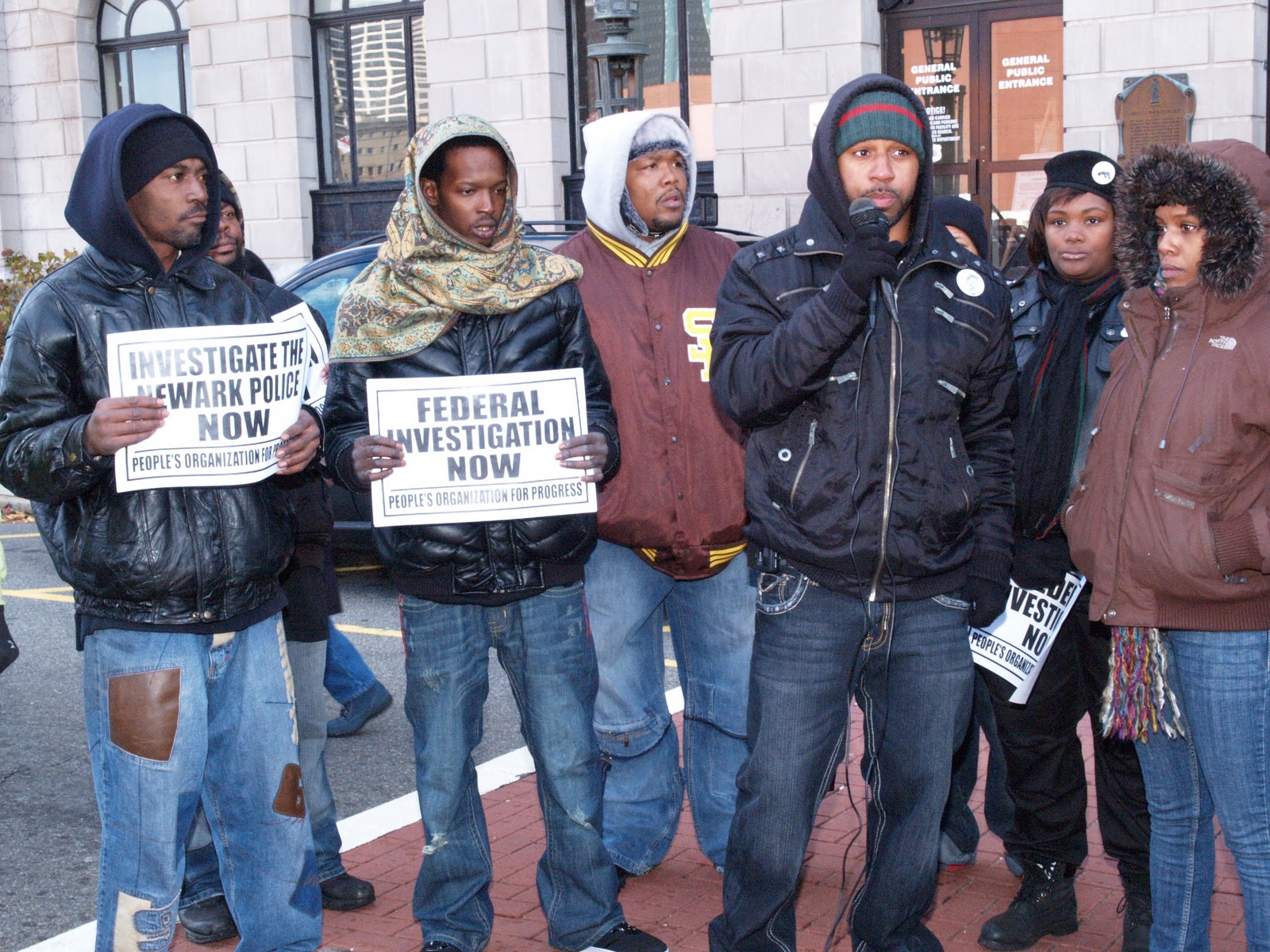 |
| Witnesses and victims of the police wilding in Irvington report |
To see additional photos from today's rally click here.
Read more!
November 4, 2010
Justice for Fritz Louissaint — Police violence in Rahway, NJ
This week our brother James Carey, Chairman of the Elizabeth branch of the People's Organization for Progress, contacted Fire on the Mountain to inform us that the People's Organization for Progress, will host a rally/march for Fritz Louissaint the mentally disturbed Haitian man who was shot 5 times at close range by Rahway Police Officers Sgt. Anthony DeCarlo and Edward O'Donnell.
May 16, 2010
First anniversary of Basire Farrell's murder shows "Hollywood" Booker is on the way out!


February 14, 2010
Black NJ: People's Organization for Progress Transforms Victims into Fighters


August 8, 2009
Black NJ demands accountability, from both the cops & Newark's celebrity mayor: "Justice for Basire Farrell"


We ask, are lives in Black skins less important than lives in white skins? We ask why is Basire Farrell's life in Black skin less important than a life in a white skin?We also ask:
We ask, why Basire Farrell couldn't survice an arrest by Seven Newark Police Officers?
We ask, why was Basire Farrell added to the list of Blacks murdered by the Newark Police?
Why did it take seven police officers to arrest one man?
Why did the police need to chase Basire Farrell, and then hit him with a police car to stop him?
How was "public safety" served by beating and kicking a man who was already on the ground and in handcuffs?
Why was Basire Farrell repeated tasered (tortured with an illegal "non-lethal" weapon that the City of Newark does not even provide to officers), while in cuffs?

May 25, 2009
The People's Organization for Progress Demands Justice for Basire Farrell

 This question about Mississippi-style white "justice" in Newark becomes especially significant with Newark's young "post-racial" mayor Cory Booker in office. The instances and incidences of police violence against the citizenry has increased since Mayor Booker took office.
January 15, 2009
From The Frontlines In Oakland: "Don't Shoot!"
[Fire on the Mountain is pleased to offer this report by a long-time Oakland resident about the community's ongoing response to the police murder of Oscar Grant.]
New Year's Day
On the early morning of January 1, I happened to be in the Emergency Room of Oakland General. Word came in that there had been a disturbance on a Bay Area Rapid Transit train at Fruitvale Station and patients were expected. The first ambulance brought in a guy who had leapt from the platform when BART police stopped a crowded train and started pulling young male “troublemakers” off. His legs were fucked up.
Then the paramedics brought in Oscar Grant. He was still alive and talking. Techs were telling him "Hang in there, hang in there," as they tried to reinflate the lungs collapsed by a police bullet and to re-transfuse the blood he was losing--fast. His heart rate collapsed and CPR brought him back so he could be wheeled into the Operating Room, but the internal bleeding couldn't be stanched in the OR, and Oscar Grant died.
There's one thing I want to highlight here. When Oscar Grant was brought in, he had a deep hole in his back, the entry wound, but on the other side you could actually see the bullet pressing out against the skin of his chest from the inside like a big pimple. It was removed on the spot. (ER personnel don't often go around fishing out bullets, unless it's life-threatening--that's TV stuff--but this one took only a quick incision to remove.) The slug was flattened, completing the picture of someone who had been shot in the back while pressed right up against a very hard, flat surface.
Anger Builds
I've been asked how come it took almost a week for the first massive protests to erupt in Oakland. I'm not sure of all the factors, but one thing is that it took a while for the videos taken by other BART passengers on the stopped train, using their cell phones, to circulate on the news and YouTube. It was in the news that the police had tried to confiscate them, but there were too many. In one of the videos, the scene of Oscar Grant's murder is framed by other cell-phone cameras being held up.
As the story became clearer, people recalled earlier BART police outrages and got madder and madder. The cops' defense, which tried to suggest that Officer Johannes Mehserle hadn't intended to kill Oscar Grant and may have accidentally drawn his handgun instead of a Taser, went nowhere. The videos were powerful testimony. One woman I know, who deals with cops professionally every day and tends to be way too sympathetic to them, tried to tell us that the videos showed the cop in “a Taser stance" and wound up leaving the room amid mocking comments.
When a protest demanding justice was called by the family at the Fruitvale Station on January 7, things began to pop. I wasn't able to attend, but friends and co-workers did. This is where the main slogan of the protests, Oscar Grant's plea on the BART platform, “Don't Shoot!” was adopted by the community.
That rally, numbering in the thousands, become a night of rebellion, as folks finally felt they had a chance to light up the cops. Several hundred young folks, white anarcho types in bandana masks and Black youths in roughly equal numbers, took the lead. There's video of the night, including a burning police car and Mayor Ron Dellums getting, let's say, a mixed response from angry Oakland residents as he tries to calm down a bunch of folks who aren't feeling at all calm.
The Struggle Continues
Yesterday, after another week had passed, my son and I attended the latest rally, called by the community-based Committee Against Police Executions (CAPE). It started at City Hall at 4 PM. Even though the news had reported that Johannes Mehserle had been arrested in Nevada on a fugitive warrant on murder charges, around 2000 people showed up. The talk from the platform did emphasize the need for “peace” but it echoed also the mood in the mood in the crowd, which was very angry. A letter from the mother of NYC police victim Sean Bell was read, and a list of names of victims of police murder called out, each answered by a crowd roar of “Don't Shoot.”
This time, Mayor Dellums had his rap down, though. He declared, and I think he's right, that the Mehserle arrest was a victory for the people's struggle. Previous killer cops in the BART system had walked away, but Oakland's anger had produced an arrest. Further, it would have to continue to insure a trial and justice, and to pursue other goals, like civilian review of the BART police force.

The mayor was followed by hiphop legend Too Short, a proud Oakland loyalist, who repeated Dellums' pitch that the crowd break up peacefully. There was a huge police mobilization to underline the call to disperse. Still, folks were not ready to go home quietly. As dark fell, many of the demonstrators, including a big contingent from the grassroots Black bike repair and customizing subculture called “scrapers,” headed out for the county building to keep the protest going.
Over the years, I've been to a lot of demonstrations, and often it feels like a duty. We are there because it is the right thing to do. This felt different, I want to say exhilarating,, although that doesn't quite catch the determination in the feeling. But as I left, I said to myself, “Where this goes, we will see. But this is the start of something, I can tell.”
December 1, 2006
Sleeping While Black (in Queens)
As a blogging newbie, I had every intention of exercising self-discipline and not going post-crazy, especially in light of the fact that nobody even knows Fire on the Mountain exists yet. But the NYPD has turned my good intentions to dust. A friend forwarded me an article from the Friday NY Daily News with this title and the laconic introduction, "Things have really gotten out of control..."
Most people reading this blog, wherever you might be from, have likely heard about the 50 police bullets fired into the car of Sean Bell, a 23 year old Black man celebrating in the early hours of the day sct for his wedding to Nicole Paultre. Bell was killed outright and two companions wounded. None of them were armed. New Yorkers are very much on edge at this blunt reminder of the deadly peril Black males face any time they come in contact with the pig.
Mayor Bloomberg knows how tense things are. Instead of automatically defending the cops a la Giuliani, he has questioned their judgement and made damn sure to be photographed with Reverends Al Sharpton and Herbert Daughtry, longtime camaigners against police brutality. But today's paper describes a reign of terror being perpetated as the cops careen through the community seeking a "fourth passenger" who somehow fled the deadly fusillade and had a gun. Read this excerpt from the column by the estimable Juan Gonzales:
Around 6 a.m. Wednesday, LaToya Smith, 26, was playing in her bed in southeastern Queens with her 7-month-old son Jalyn.New York may not blow over this, but an old wound has been torn open and it will not heal any time soon. (Modern Pitung, at the blog All Out for the Fight, has pointed out one bright spot--the solid response by the John Brown caucus of the newly-formed NYC SDS/MDS chapter.)
Just then, she heard a strange noise in her family's darkened house. Her locked bedroom door suddenly burst open, and several uniformed cops burst into the room with flashlights and guns drawn.
According to Smith, the cops ordered her to lie facedown on the floor.
"My baby, my baby. Where's my baby?" she recalls pleading to them as they hustled her into the living room. There, they gathered her brothers Timothy Smith, 19, and Stanley Smith, 23; her mother, Laura; the baby and Christopher Keys, 18, a friend who was staying in the apartment. Meanwhile, a dozen officers searched the entire place.
Police officials said they found a loaded 9-mm. pistol in the apartment and a small bag of marijuana, whereupon they hauled the young woman and the three men to the 103rd Precinct stationhouse. They charged the men with gun possession, but released LaToya Smith.
Police also are saying the apartment was a known drug-dealing location.
But the real purpose of the raid was not to find guns or pot.
All the cops' questions at the stationhouse were about last weekend's police shooting of Sean Bell, Joseph Guzman and Trent Benefield outside the Kalua Cabaret, Smith said.
They kept asking if she knew the whereabouts of certain friends of the three men shooting victims.
"If you don't tell us what we want to hear, you know, you can get five years," she says one cop told her.
UPDATE
Anybody thinks that I'm throwing too much drama with a formulation like "New York may not blow over this" ought to give a listen to "50 Shots," the cut by rapper Papoose just posted at the online music mag Prefix. You're not listening to fabulous flow or lyric brilliance, you are listening to raw anger. (h/t to Steve Gilliard)
UPDATE 2
12/4
These pictures are to accompany the new comment on this thread by Bondi on media coverage of this week's demo in Newark, NJ around Sean Bell organized by the People's Organization for Progress.

 Read more!


