Showing posts with label police murder. Show all posts

July 2, 2015

Two Trips, To Kent State And To Jackson State, 45 Years On


This May I took it upon myself to attend two memorial observances, the 45th anniversaries of the massacres at Kent State and Jackson State.
On May 4, 1970, four students were gunned down by the Ohio National Guard at Kent State University as part of a massive upsurge against the war and for social change that was sweeping American campuses. Ten days later on May 14, Mississippi state troopers and Jackson police opened fire on a student protest at Jackson State, killing two young men, James Earl Green and Phillip Gibbs, in a massive fusillade. These two shootings were critical points in the events of May ’70, the most massive and militant nation-wide student strike this country has ever seen. (I have written a series of pieces on May ’70, 19 of them and counting.)

Here are a few reflections based on what I observed. Please bear in mind that I had not been back to the battlefield at Kent since 1994, and this was my first trip to Jackson State.

1. I am goddamn old. I was an adult, a young one, when this shit happened, and that was going on half a century ago.

Nevertheless, like many who were around then, I am unlikely to forget these killings before I check out.

2. Amidst numerous moving and inspiring moments, I want to cite two that struck me particularly. The May 4 Visitors Center at Kent State, one of the most important victories won there in the long struggle against forgetting, has as its centerpiece a short film, 9 minutes perhaps, with many photographs and sound recordings of the deadly moments around the National Guard firing. I sat through it three times.  If you are ever within, say, a three hour drive, you should watch it.

At Jackson State, the then-president of the school, Dr. John A. Peoples, described the aftermath of the shooting. He told how for the next four years at every sporting event the school’s team played in, Jackson students greeted the national anthem by standing silently with their fists in the air, Tommie Smith & John Carlos-style. His pride was evident, as was his quiet delight when he described sitting next to the governor of Mississippi at one such game.

3. Kent is an amazing anomaly. For forty-five straight year people have made hajj to the campus from across the country, joining with a core of regulars associated with the university and the town of Kent to remember May 4, 1970. I cannot think of anything comparable in the left movement in this country. In New York there is an annual memorial for the victims of the Triangle Shirtwaist Fire. In Bay View, WI, now part of Milwaukee, the local labor movement remembers the 1886 murder of seven strikers by National Guardsmen at a steel mill. Both of these events are mainly local in character and both date in their current form to the revival of labor militancy and interest in the working class during the '60s and '70s.

Why is Kent so different? The most obvious thing is that it was white college kids who were shot, on their campus, by the National Guard. It stunned the country at the time, a time when hundreds of thousands of us were on strike at our own campuses. This was reinforced by the classic musical mnemonic, "Ohio" written by Neil Young and pushed into immediate release by Crosby, Stills, Nash & Young in the aftermath of the killings.

Further, the university administration did its best to obliterate all memory of the killings. This led in 1977 to Tent City, erected to block the construction of a gymnasium on the murder site, and to a decades-long campaign of militant struggle rejecting further attempts to kill or to coopt and dilute the memory.

Nowadays, May 4 is observed by several days of talks, forums, and culture. One I attended was run by young members of Black United Students, whose powerful panel and heartbreaking stories laid bare how little has actually changed since their predecessors were organizing and protesting racism and discrimination at Kent in 1970.

The heart of the observance is memorial rituals now enshrined by time: a candlelight march as May 3 turns into May 4, this year numbering 335, followed by a vigil in which volunteers take rotating shifts holding candles at the now-memorialized spots where the four fell. (I stood for Jeffrey Miller and Sandy Scheuer at different points during the night). It culminates with an emotional memorial program.

While folks come from around the country to take part, the commemoration is centered on Kent people. In addition to nationally recognized spokespeople like my old compa Alan Canfora and Tom Grace, there is a core of people residing in Kent who do the invisible work that makes it happen. Here I will single out as representative the folk I stayed with there, Mike Pacifico and Kendra Hicks Pacifico, whose basement is a well-organized stash of decades worth of banners, candles and other nuts and bolts of the protest. And the ongoing student group, the May 4 Task Force, provides not just bodies but leadership.

The whole comprises what old hands call the Kent May 4 Family. And in multiple ways it is a family. First, relatives of the fallen have been part of it from the start. Most of the parents, active from the start, are now dead or are unable to attend. Laurel Krause, Alison’s sister, is always a presence. So is Alan Canfora’s sister, Chick, another Kent alum. Beyond that, family members of longtime participants who have been brought to Kent since they were itty-bitties have now come on their own. And new regulars are adopted, like Canadian photographer Christian Bobak who came to document the anniversary five years ago and has returned every year since.

4. At Jackson State this year, a short memorial program was followed by a panel with vigorous participation from veterans of May, 1970 in the audience. Apparently, annual programs had fallen by the wayside in some past years but with the rise of the Black Lives Matter movement focused first and foremost on police killings of young Black men, this year’s program had to happen.

Where the observation at Kent State University was overwhelmingly white, the 110 or so at Jackson State were at least that Black. Participation was even older than at Kent. The two activists in their twenties who drove me down from Memphis were among the youngest people there, save for a few in strollers.

The formal program was attended by about blessedly short given the outdoor heat and lack of shade. Bjorn, one of the Tennesseans I traveled with, summed it up as highlighting students from 1970 who had gone on to academic or professional success, and marked by frequent references to the events of May 15 as “a tragedy.” Jackson’s new Chief of Police, a younger alum, had to say he knows what people are thinking about police these days and why, and pledged that there would be no such occurrences on his watch.

Maybe 50 people stayed for the forum after, and folks there were plenty clear. What happened in May 15, 1970 was not “tragic," it was murder. Murder by the police. It was fascinating to watch the veterans share their experiences and try and pull together what they had seen into a larger, more coherent picture of the deadly assault they had survived. Comparisons to the present murders of young African-Americans were blunt and frequent. And I wish every white yahoo who responds to police violence by going on about Black-on-Black violence could have been there to listen to folks from the community grapple with the problem.

(Both halves of the program were livestreamed by Jackson State; video can be viewed here.)

5. LONG LIVE THE SPIRIT OF KENT AND JACKSON STATE! was the slogan that resonated through the student movement in the 70’s and 80’s. Folks that were active in 1970 will, to this day, automatically respond to mention of Kent State by saying “and Jackson State.” Thus, the struggle for memory, and against the tendency of the fiercest of people’s battles to be crammed down the Great American Memory Hole, has also helped keep the memory of the Jackson killings alive far beyond the borders of the campus itself.

Activists in the May 4 movement at Kent have always worked to maintain ties with Jackson State. For years until his untimely death earlier this decade, Gene Young represented Jackson at Kent State every year and was a cherished figure in the community there.

Still, the greater attention to Kent in memory and in history as it is taught and written in this white supremacist country is obvious. It clearly rankles many of the veterans at Jackson State. Several made a point of complaining that the protest at Jackson is too often described as an anti-war protest and not primarily as a protest against the multi-faceted racism directed at Black students in the capital of Mississippi in 1970.

6. It is only natural that the focus on Kent (and, always, Jackson) in the May 4 commemorations carries with it a certain built-in narrowness. While the killings at Kent kicked the national student strike into overdrive, it was already the largest and most powerful student protest in the history of the country.

The thing about Kent is that the administration closed the campus up tight on the afternoon of May 4 and ordered everyone to leave. From the standpoint of Kent, the May '70 story pretty much ends here, but those of us who were around during that fateful month know this was only part of the story. The truncation of the narrative can be seen clearly in the May 4 Visitor’s Center. The Kent-centrism is reflected in the three parts of the museum. The build-up section presents a broad picture of the 60’s and the tectonic shifts in politics, society and culture that that gave rise to the earthquake that was May 1970. The central section is the film about the events of that day. The third part is heavily focused on various responses to the Kent killings, with some attention to Jackson State.

The fact that the movement went on to greater heights, more militant battles, and striking accomplishments is absent. I spoke with two paid staffers, neither of whom knew about the police killings of six young Black men in Augusta, Georgia between the shootings in Kent and Jackson, or about the “hard hat riots,” savage attacks on protestors by union construction workers, organized in conjunction with President Nixon’s White House.

This is baked into the long struggle at Kent and it is not the particular responsibility of activists there to correct it. That falls rather to veterans of all the battles of May 1970: step up, dredge up the memories and spread the lessons, as folks have been doing at Kent and Jackson all these years.

7. There were some intriguing parallels at the two events.

Both sets of May 1970 veterans emphasized the organized nature of the murderous attacks—at Kent, the National Guard unit wheeling, kneeling and firing in unison into the unarmed students, and at Jackson the way the po-po marched in order up Lynch Street before turning to fire on the students.

Similarly, some people at both campuses seem driven to deny that the burning of the ROTC buildings there were the work of campus protesters. At Kent, the conspiracy-minded attribute not only the May 2 fire but also the cutting of firehoses to prevent it being extinguished to the work of provocateurs directed by the feds. At Jackson, the tendency is to blame vandalism by “the corner boys,” young Black men who hung out in the neighborhood of the campus. Well, maybe. But let’s not forget that 30 ROTC buildings developed problems which compromised their structural integrity, shall we say, during the first week of May 1970. Thirty. I know for a fact that some were not the work of provocateurs or “outside elements.”

We have two books to look forward to, both headed for publication. Tom Grace, wounded on May 4 and now a professor in Buffalo, will add his analysis to the considerable body of works on Kent State. The absence of a comparable shelf full of books dealing with Jackson State is to be improved by Dr. Nancy Bristow of the University of Puget Sound, who is finalizing a definitive study.

Best of all is a little script flip. At Jackson State, a white prof, Dr. Robert Luckett of the History Department, evidently played an important role in organizing the program. At Kent the faculty adviser of the student May 4 Task Force for more than a decade is a lecturer in the Department of Pan-African Studies, Idris Kabir Syed, who also acts as adviser to Black United Students there. Sweet, hunh?

8. Finally, I want to issue a challenge to the Kent State May 4 Family and to others, old school veterans and new activists alike, who hold the memory of the events of May ’70 in their hearts. A Venn diagram of the attendees at the Kent and Jackson observations this year would show the circles intersecting at one point. Me. That ain’t right. If there is a 46th anniversary celebration at Jackson State next year, I hope you will join me there.

Read more!

July 9, 2010

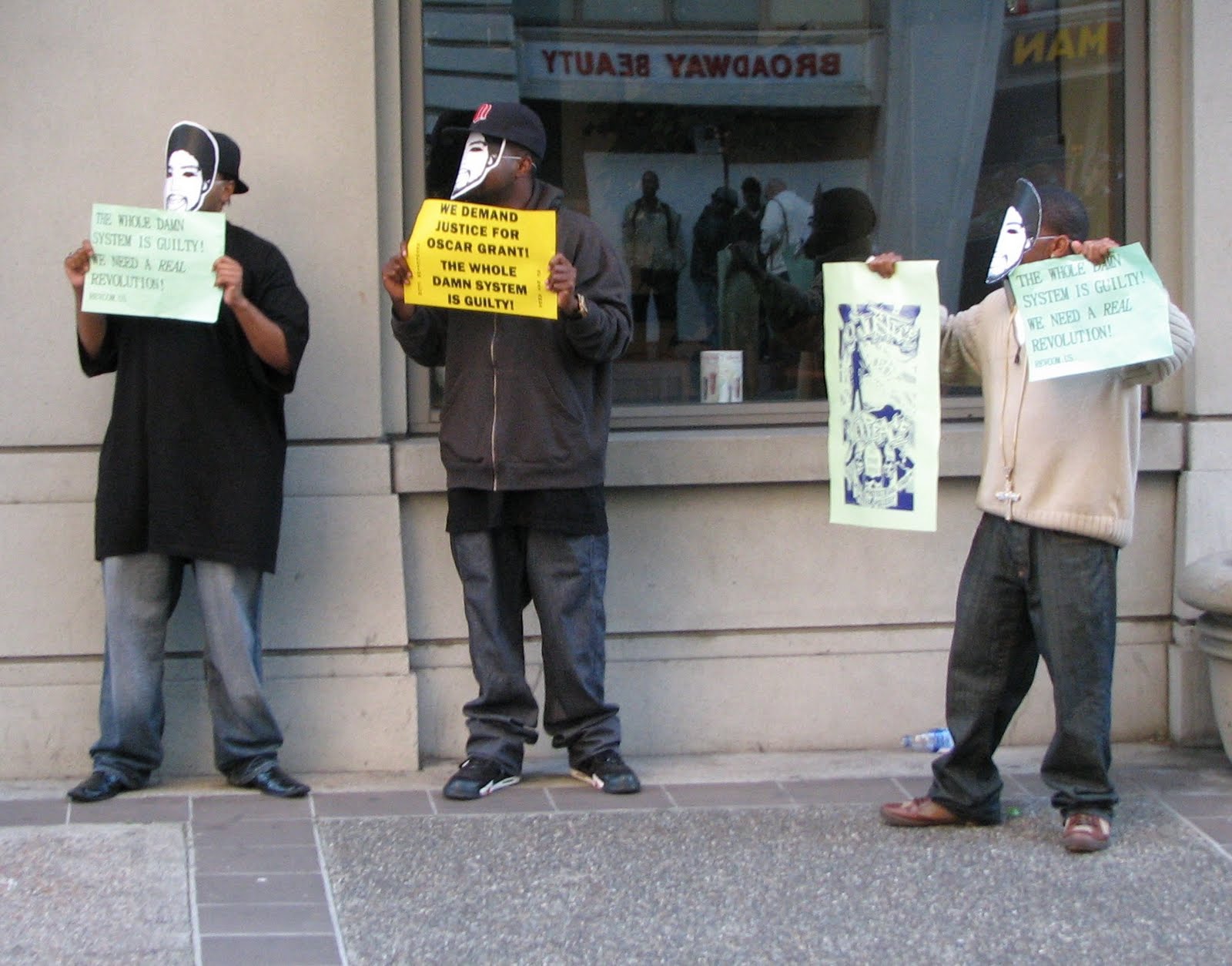
Oakland Says Guilty! Justice For Oscar Grant!


[The verdict on killer cop Johannes Mehserle is in. An all-white jury in Los Angeles has determined that the act of shooting year-old Oscar Grant in the back while he lay handcuffed and face down on the Oakland BART station platform constituted involuntary manslaughter (an “oopsie” verdict which will give him a maximum of 4 years in the slams). As the verdict approached, Oakland had tensed for a re-run of the rebellion which ripped there after the killing.

An old friend did a quick report on that initial eruption here at FotM and followed up last week with some thoughts on the mood in Oakland as trial summations were delivered. In the middle of last night he sent in the following hasty notes and photos when he got home from the action downtown. But let him tell it:]


By the time I got there late (7:30 pm), the crowd had thinned to 800. Not sure how much more it had been. I expected larger . I think the police buildup and pre-verdict hype I wrote about last week had some, perhaps many, scared. Many of my son's friends (high school age) were told they couldn't go for fear of the violence.

The rally was still on with some speakers, mainly those who walked up to the mike and wanted to say something--the big names musta come and gone before.


I heard Jabari Shaw, president of the Black Student Union at Laney College in Oakland, complement the multi-racial make up of the crowd and declare that we must focus our anger on change to go beyond venting our anger on the businesses in the area, that we need to change the whole damn system.


Bobby Hutton's niece spoke! (Bobby Hutton, or "Lil' Bobby," was the youngest member of the Black Panther Party. He joined soon after the conception of the BPP in 1966 at the age of 16. On April 6, 1968, he was killed by Oakland Police after a firefight. According to witnesses, police shot him more than a dozen times after he had surrendered and had stripped down to his underwear to prove that he was unarmed.)

She talked of the services that the Black Panthers provided, free breakfast programs and daycare for the kids. She said that these services are still needed in our community now, that people are still hungry, but that the BPP had been decimated by the police. And concluded that this legacy of African Americans being murdered by cops was nothing new.


The rally officially ended shortly after 8pm. Many of those left milled around, some moved to an adjacent intersection. Police presence was incredibly large with all streets leading from the intersections cordoned off by police from various jurisdictions--CHP, Hayward, Berkeley, Fremont, Alameda, Oakland, to name a few that I heard of. Reports from people driving on the freeways between 4pm and 5pm were that large convoys of police cars, including armored vehicles of some sorts, went whizzing past everyone, lights blazing. Some of these reportedly had 20 or more vehicles in a group.

Some bottles and cans were thrown towards a line of police. This sent many in the crowd running away, jittery from the pre-verdict, riot-that-will-be-Oakland hype I wrote to you about last week. Some windows were broken, which soon had more in the crowd leaving the area. Police at that point were putting on gas masks and letting people leave the cordoned-off section of downtown but not enter.

At one point about 20 CHP cars came screeching into the area, lights and sirens blazing.The CHP had criss-crossed their side windows with duct tape, presumably to prevent them from being broken.


The crowd by now was getting down to 150 or so, I would estimate. Many wore bandanas over their faces, or Oscar Grant masks.

... At this point I took my boys and myself out of the area. The noose was being tightened and I didn’t have bail money for all of us :)


This Just In:

Taping side windows does not protect windshields!


Read more!

May 16, 2010

First anniversary of Basire Farrell's murder shows "Hollywood" Booker is on the way out!


One year ago Saturday, May 15, when Newark police beat Basire Farrell to death while in handcuffs, Mayor Cory Booker was riding high on the Oprah Effect (see Black NJ: People's Organization for Progress Transforms Victims into Fighters, and Hollywood Mayor Looks to Move Up — And Out of Newark for previous FotM coverage of this case). This "Hollywood Bubble" seemed to grant our pretty young mayor license to commit heinous acts that no Newark leader has gotten away with since Hugh Addonizio "literally delivering the city into the hands of organized crime," according to the former U.S. District Judge who tried the case. And if you ask Newark residents of the period, turning over city government to the mob was less significant than the violent police attacks on the Black community.
With Mayor "Hollywood" Booker, once again the cops have an Addonizio-esque freedom to harrass our youth. Booker's self-proclaimed success heading into the recent election was that he'd reduce crime, a complete fabrication based on funny-math and manipulated statistics. And while some commentators may point to the fact that Booker retained the mayoralty by a 59% margin, the most telling indicator is how well Cliff Minor did with minimal funding. Minor defeated Booker the South Ward 5,028 to 4,025, notwithstanding the more than 20-to-1 campaign-finance difference. Likewise, Cory's staunchest ally, South Ward Councilman Oscar James, lost by a landslide to Ras Baraka.
Councilman Ras Baraka addresses rally at the site of Basire Farrell's murder
What does this have to do with the police murder of Basire Farrell? It was probably best explained by District Leader Lynda Lloyd, herself a victim of police brutality, who thanked and congratulated Ras Baraka for attending the rally. "Oscar James would never have attended this rally," Ms. Lloyd said, referring to the previous councilman.
South Ward/Clinton Hills District Leader Lynda Lloyd
Basire's aunt, Sharonda Smalls, echoed these sentiments through barely controlled tears as she called for accountability from elected officials for ALL police violence in Newark and Essex County. Sharonda, a true people's leader in both POP and the South Ward, applauded Councilman Baraka for his commitment to the community. Ms. Smalls spoke from personal experience about Baraka's role as a teacher and school principal. "We know, love, and respect this young man," she said, "who has served as a mentor to so many of us and our children."

Read more!

February 14, 2010

Black NJ: People's Organization for Progress Transforms Victims into Fighters


Updated: Sunday afternoon, February 14
The People's Organization for Progress has a proud history of battling oppression in Northern NJ, for well over a quarter-of-a-century. We've organized around the needs of the people: education, jobs, healthcare, racism, war, reparations, imperialism, and more for over 26 years. But POP "made its bones", has made some of it's greatest contributions, in the struggle against police violence in the African-American community.
The conviction and imprisonment of five Orange, NJ police officers for the death of Earl Faison, the settlement in the police murder of Stanton Crew, the financial fine imposed on East Orange, NJ for the police attack on senior-citizen Esmé Parchment in her own house, these are proud moments in POP's history of struggle.
But perhaps the most exciting achievement we get to experience as POP members is when a victim, through their pain, trauma and experiences, is transformed into not just a fighter, but a leader in the people's battles. Our recently elected Vice-Chair for Internal Affairs, Mary Weaver is one such leader. After losing her son to a police bullet, Mary joined POP to get justice. Over time however Mary became Recording-Secretary and then Secretary General as she helped build and transform POP as one of our leading members.
This past Saturday, February 13, Sharonda Smalls, aunt of Basire Farrell (who was beaten to death by Newark police on May 15 of last year), called for a demonstration at the site of her nephew's murder. But Sharonda, in the spirit of Mary Weaver and other victims whose experiences have transformed them into soldiers in the people's struggle, called for a demonstration for all victims. As she herself formulated the demand "to Protest the Vicious and Senseless Beating Death of Basire Farrell & All Victims of Police Brutality by Newark Police Officers."
Sharonda explains this transformation, "we are all family. At last Thursday's POP meeting, when I met the family of Darnell (murdered by a so-called law enforcement officer) I realized I'd gone to school with his mother." Local Democratic Party District Leader Lynda Lloyd became a member of Sharonda's POP family as well. Lloyd attended the rally to find out more about police brutality in the Clinton Hills neighborhood, because she herself had been beaten and arrested on January 27 by Booker's lawless storm troopers.
And even in the frigid cold weather, victim's families answered Sharonda's call. The families and friends of Jahqui Graham, Darnell McNeil, Basire Farrell, Amar McClean, and many many others came to Tillinghast St. at the corner of Clinton Place and Homestead Park in Newark in the spirit of linking these struggles. The family of one recent victim, Darnell McNeil, a slight young college tutor shot to death by an Essex County Sheriff's Deputy moonlighting as "muscle" at a club, announced that his funeral on Monday, February 15, would follow the South African model with a march afterward. Younger community residents also called for building a People's Organization for Progress youth-wing.
As People's Organization for Progress Chairman, Lawrence Hamm pointed out, "Grieving is necessary, we all need to mourn after tragedy. But the spirit of activists like our own Vice-Chair Mary Weaver and new POP member as well as developing new neighborhood leader Sharonda Smalls teaches us that our salvation is tied-up to the safety, health and vigor of the community. In fact, only by linking the battles to include ALL injustice can we achieve any real victories at alll!"

Read more!

August 8, 2009

Black NJ demands accountability, from both the cops & Newark's celebrity mayor: "Justice for Basire Farrell"


This past May, Fire on the Mountain reported on the beating death by Newark police officers of popular Clinton Hills neighborhood resident Basire Farrell within blocks of Mayor Cory Booker's residence (see The People's Organization for Progress Demands Justice for Basire Farrell for the May posting). By August, in the heat of the summer of 2009, this year's spate of police-sanctioned murders has only increased…
The community response to this outrage became a flood of discontent as more than 100 residents, New Black Panther Party supporters, and People's Organization for Progress members shut down Newark's central business intersection at Broad & Market Streets this past Wednesday evening (see this video).
This weekend, after pointing out that we were picking the Newark Police Headquarters at 31 Green Street on a Saturday for the convenience of family members and working people, POP NJ State chairman Lawrence Hamm upped the ante, stating that next time, we would be around the corner from the Police Headquarters, "at City Hall on a week day, to confront Mayor Booker and the Police Commissioner, and demand a response."

As the leaflet from People's Organization for Progress stated:
We ask, are lives in Black skins less important than lives in white skins? We ask why is Basire Farrell's life in Black skin less important than a life in a white skin?
We ask, why Basire Farrell couldn't survice an arrest by Seven Newark Police Officers?
We ask, why was Basire Farrell added to the list of Blacks murdered by the Newark Police?
We also ask:
Why did it take seven police officers to arrest one man?
Why did the police need to chase Basire Farrell, and then hit him with a police car to stop him?
How was "public safety" served by beating and kicking a man who was already on the ground and in handcuffs?
Why was Basire Farrell repeated tasered (tortured with an illegal "non-lethal" weapon that the City of Newark does not even provide to officers), while in cuffs?
The death of Basire Farrell is simply a single example of an every-increasing number of homicides that police officers in Essex County are either directly responsible for or complicit in. These include Randy Weaver, Jahqui Graham, and many, many others.

Justice for all victims of Police Brutality!

(See a YouTube video of Chairman Hamm's speech this past Saturday at 31 Green Street in Newark)

Read more!

May 25, 2009

The People's Organization for Progress Demands Justice for Basire Farrell

"What is this? Mississippi, 1955? Black people can't even get to the precinct?"
Lawrence Hamm, state chairman of the New Jersey-based People's Organization for Progress, was  angered nearly to tears in front of Newark's 5th Precinct. Well-liked neighborhood resident Basire Farrell had been stopped by police near at the intersection of Clinton Place and Tillinghast Street. According to eyewitnesses, the police had Farrell in handcuffs, yet continued to hit and kick him, apparently beating the 30 year-old young man to death (see the Newark Star Ledger report here).

This was not POP's first march to this particular Precinct House, the home base of at least two similar cases in the past year. As POP chairman Larry Hamm noted, "I don't care whether people do it in white sheets or a blue uniform, it sounds like a lynching to me."

This question about Mississippi-style white "justice" in Newark becomes especially significant with Newark's young "post-racial" mayor Cory Booker in office. The instances and incidences of police violence against the citizenry has increased since Mayor Booker took office. 

In fact, it is not that long ago that Mayor Booker proudly proclaimed to  TV-networks and print media alike that the kind of police "over-reaction" that led the street rebellion that he describes as the "1967 Riot" are behind us. Attacks like the murder of Basire Farrell, not more than a few blocks from the mayor's residence, put the lie to that claim.

Justice for Basire Farrell, and all victims of police brutality!

Read more!

January 15, 2009

From The Frontlines In Oakland: "Don't Shoot!"

[Fire on the Mountain is pleased to offer this report by a long-time Oakland resident about the community's ongoing response to the police murder of Oscar Grant.]


New Year's Day

On the early morning of January 1, I happened to be in the Emergency Room of Oakland General. Word came in that there had been a disturbance on a Bay Area Rapid Transit train at Fruitvale Station and patients were expected. The first ambulance brought in a guy who had leapt from the platform when BART police stopped a crowded train and started pulling young male “troublemakers” off. His legs were fucked up.

Then the paramedics brought in Oscar Grant. He was still alive and talking. Techs were telling him "Hang in there, hang in there," as they tried to reinflate the lungs collapsed by a police bullet and to re-transfuse the blood he was losing--fast. His heart rate collapsed and CPR brought him back so he could be wheeled into the Operating Room, but the internal bleeding couldn't be stanched in the OR, and Oscar Grant died.

There's one thing I want to highlight here. When Oscar Grant was brought in, he had a deep hole in his back, the entry wound, but on the other side you could actually see the bullet pressing out against the skin of his chest from the inside like a big pimple. It was removed on the spot. (ER personnel don't often go around fishing out bullets, unless it's life-threatening--that's TV stuff--but this one took only a quick incision to remove.) The slug was flattened, completing the picture of someone who had been shot in the back while pressed right up against a very hard, flat surface.

Anger Builds

I've been asked how come it took almost a week for the first massive protests to erupt in Oakland. I'm not sure of all the factors, but one thing is that it took a while for the videos taken by other BART passengers on the stopped train, using their cell phones, to circulate on the news and YouTube. It was in the news that the police had tried to confiscate them, but there were too many. In one of the videos, the scene of Oscar Grant's murder is framed by other cell-phone cameras being held up.


As the story became clearer, people recalled earlier BART police outrages and got madder and madder. The cops' defense, which tried to suggest that Officer Johannes Mehserle hadn't intended to kill Oscar Grant and may have accidentally drawn his handgun instead of a Taser, went nowhere. The videos were powerful testimony. One woman I know, who deals with cops professionally every day and tends to be way too sympathetic to them, tried to tell us that the videos showed the cop in “a Taser stance" and wound up leaving the room amid mocking comments.

When a protest demanding justice was called by the family at the Fruitvale Station on January 7, things began to pop. I wasn't able to attend, but friends and co-workers did. This is where the main slogan of the protests, Oscar Grant's plea on the BART platform, “Don't Shoot!” was adopted by the community.

That rally, numbering in the thousands, become a night of rebellion, as folks finally felt they had a chance to light up the cops. Several hundred young folks, white anarcho types in bandana masks and Black youths in roughly equal numbers, took the lead. There's video of the night, including a burning police car and Mayor Ron Dellums getting, let's say, a mixed response from angry Oakland residents as he tries to calm down a bunch of folks who aren't feeling at all calm.

The Struggle Continues

Yesterday, after another week had passed, my son and I attended the latest rally, called by the community-based Committee Against Police Executions (CAPE). It started at City Hall at 4 PM. Even though the news had reported that Johannes Mehserle had been arrested in Nevada on a fugitive warrant on murder charges, around 2000 people showed up. The talk from the platform did emphasize the need for “peace” but it echoed also the mood in the mood in the crowd, which was very angry. A letter from the mother of NYC police victim Sean Bell was read, and a list of names of victims of police murder called out, each answered by a crowd roar of “Don't Shoot.”

This time, Mayor Dellums had his rap down, though. He declared, and I think he's right, that the Mehserle arrest was a victory for the people's struggle. Previous killer cops in the BART system had walked away, but Oakland's anger had produced an arrest. Further, it would have to continue to insure a trial and justice, and to pursue other goals, like civilian review of the BART police force.


The mayor was followed by hiphop legend Too Short, a proud Oakland loyalist, who repeated Dellums' pitch that the crowd break up peacefully. There was a huge police mobilization to underline the call to disperse. Still, folks were not ready to go home quietly. As dark fell, many of the demonstrators, including a big contingent from the grassroots Black bike repair and customizing subculture called “scrapers,” headed out for the county building to keep the protest going.


Over the years, I've been to a lot of demonstrations, and often it feels like a duty. We are there because it is the right thing to do. This felt different, I want to say exhilarating,, although that doesn't quite catch the determination in the feeling. But as I left, I said to myself, “Where this goes, we will see. But this is the start of something, I can tell.”


Read more!

April 26, 2008

Early Response to Sean Bell Verdict

bloglines del.icio.us Digg facebook Google Ma.Gnolia Newsvine Technorati socializer StumbleUpon Yahoo


People’s Justice had called for a protest in front of the Queens District Attorney's office at 5:30 p.m. in the event of an acquittal for the police officers who killed Sean Bell. FYI, People’s Justice is an impressive network of organizations and projects led mostly by under-40 people of color, like Malcolm X Grassroots Movement, Audre Lorde Project, Immigrant Justice Solidarity Project. Though there had been an angry gathering in front of the Court House right when the verdict was announced, this was the first planned response for which a broad call had been issued.

On first view, the scene was a little disheartening: crowd of a few hundred, bad sound system, not much focus, and the usual suspects--the organizing groups and SDS and some other young people, plus the hard left and too many middle-aged people who looked familiar to me. The grassy knoll near the court offices obviously didn’t get a lot of community foot traffic or passers by. And despite the incredible rage evident at many workplaces that day, the remote location (35 minutes from midtown by train, much more from Harlem, Brooklyn or the Bronx) and the end-of-work week timing had clearly limited the turn-out.

As the sound improved, it was possible to hear Sean Bell’s step-brother, I believe the only family member who spoke, yelling “F…the police,” a chant picked up by some of the crowd. Overall the tone was angry, militant, purposeful, determined to respect the family’s call for non-violence but determined also to make the system pay.

Things picked up with the call to march. Gathering together and moving we were louder and had more momentum, though I wasn’t the only one not clear about our destination—which turned out to be the Club Kahlua, where the shooting happened. The police didn’t try to stop us from taking Queens Boulevard and they clearly had been ordered to be cool, with many community officers present.

After almost a mile, we turned onto Jamaica Avenue, a much busier street with stores and pedestrians doing errands. Here people started to join the march and the chanting grew louder. We reached a thunderous level with the help of the echo effect under the Archer Avenue subway and Long Island Railroad Station, stopping for a couple of minutes and chanting “Sean Bell, Sean Bell." Turning onto the street where the shooting happened, we were joined by more local residents. One woman got in her car and hit the horn to amp up our volume on the chants, others seemed to bring more noise-makers out of their houses. Organizers led a count to 50 shots, a moment of silence, and asked for a pledge to keep struggling against police brutality and for people’s power.

At this point, most elders left while some youngbloods marched around the neighborhood and into the projects. Walking back, we wound up next to an African-American young woman in her early teens, holding her little brother by the hand. She was talking very excitedly into her cell phone: “See, I told you there was gonna be a protest! So when I heard the people yelling, we came out and marched and I taped the whole thing…”

Read more!

December 18, 2006

Sean Bell & Peyton Strickland—Compare and Contrast!


For the third but undoubtedly not the final time, Fire on the Mountain turns to the simmering rage in NYC’s Black community about the 50-shot police murder of the unarmed Sean Bell in the early hours of his wedding day, November 25.

Ajamu Dillahunt on his North Carolina-based blog Sankofa Meets the Future has drawn an instructive comparison between the Sean Bell case and another recent police shooting. A young man in Wilmington, NC named Peyton Strickland was killed on December 1 as a heavily-armed police task force followed up a complaint that he had stolen two new Play Stations. Peyton Strickland was killed when Deputy Christopher Long of the New Hanover County Sheriff's Office Emergency Response Team fired his pistol through the front door, even as it was being knocked down by a police battering ram. The unarmed Strickland was hit in the head and shoulder, fatally.

By December 8, just a week after the shooting, Deputy Long was fired from the Sheriff's Office. On December 11, he was indicted on charges of second-degree murder brought before a New Hanover County grand jury by District Attorney Ben David:

After interviews with other law enforcement personnel at the scene, it became clear that Long's perception "was not the belief of others," David said. Long's actions were not "objectively reasonable," David said, even though the ERT had information that the occupants of the house might be armed and dangerous. To obtain a second-degree murder conviction, prosecutors must prove that Long committed an unlawful killing with malice, but not premeditation and deliberation.


Is anyone reading this surprised to learn that Peyton Strickland was white and that his father is a prominent attorney in the Durham area?

I didn’t think so.

In NYC, we have a crime just as egregious being played out as a shell game, with politicians like Bloomberg, police spokespersons and the media shuffling statements of concern, declarations of fealty to the legal process and broad hints about fleeing, gun-toting friends of Sean Bell. Only calculated leaks from within the NYPD have provided any information. One nugget that has come out is that a couple of the killer cops reported that they didn’t know whether they had fired their guns or not! These people are still on the payroll. Feel safer, New Yorkers? The Queens District Attorney can’t tell us when, if ever, a grand jury might be convened or what charges it might consider.

As Ajamu Dillahunt points out:

So what we have in Wilmington is a swift action against a law enforcement officer... in a case that is no more compelling then the deaths of Sean Bell, Amadou Diallo and countless hundreds of other People of Color who are victims of "armies of occupation" in our communities. Clearly Strickland's racial, ethnic and class background have compelled the Sheriff and the District Attorney to move quickly and seriously.
In closing I want to call attention to another important point the first Sankofa Meets the Future piece makes. It cites a local news story on the family’s response:

His father, Durham-area lawyer Don Strickland, said Saturday that he would address Long's firing "at the appropriate time."

"Right now, I'm just going to let the judicial process do its work," Strickland said.

Can anyone reading this imagine the parents of an African American victim of police murder in New York City proclaiming that they’re going to be quiet and let the system work?

I didn’t think so.

As Ajamu Dillahunt sums up:

While he may not be conscious of it, only a sense of White Privilege positions a person to take this approach to such a serious blow to their family. His legal background and experience with the criminal justice system may be responsible for him refraining. In contrast, Black and Latino families, based on a long history of injustice in these kinds of investigations have usually joined communities in speaking out against the atrocity and have often joined the outraged masses in the streets.

Read more!

December 17, 2006

Ten of Thousands March for Sean Bell


Yesterday, I joined some tens of thousands of New Yorkers in a solemn demonstration demanding justice for Sean Bell, the unarmed 23-year-old Black man gunned down by NYC cops while leaving his bachelor party, less than 12 hours before his wedding.

And it was one hell of a demonstration. Tens of thousands of us—I’m pretty good at counting marches but this one was just too damn big—strode down Fifth Avenue past the iconic Rockefeller Center tree in the middle of all the Christmas shopping hoo-hah. The media keep calling it a silent demo, because it was announced as one. Not hardly—plenty of chants and unison counting up to 50, the number of shots in the fusillade that killed Sean Bell and wounded two friends in his car.

A few observations follow—add your own in the comments, please.

1. The march was overwhelmingly Black, 80-85%, I’d say. The African American turnout was likely slightly lower because of a solid turnout from Africans and Haitians. Also significant, it was not a particularly young demonstration—there were plenty of kids and junior high students there with parents or grandparents, and even some high school kids seemed to be in family mode. I would say the bulk of the crowd ranged in age from 35 to 70, and judging by signifiers like neat dreads, kofis, and mudcloth jackets, they were folks who had actively identified with the upsurge of the Black Liberation Movement in the ‘60s and ‘70s. There were banners from unions, church groups, NAACP chapters, the National Action Movement, and so on, but the number of folks from unions and churches exceeded the organized contingents by an order of magnitude or two. This was a noteworthy chunk of NYC’s Black working class on the move.

I recognized more of the white folk marching than I would have liked. Beyond usual suspects, folks turned out by their unions, and clumps of lefties, organized predominantly white contingents were few and far between. UFPJ, to its credit, was there with a big banner and a modest and well-framed flier, and there was supposed to be a NOW demo around the killing downtown at City Hall an hour earlier. If those folks subwayed up, I didn’t see ‘em.

2. Signs proclaiming “Improve Police and Community Relations” were handed out free by the NAACP and predominated, but there were plenty of homemade efforts as well. The NJ–based People’s Organization for Progress had two distinct clumps in the march (contingent integrity was very difficult to maintain in the jam-packed assembly area), but their distinctive signs—with much more direct and militant slogans--were scattered throughout the march as well. Many in the crowd addressed themselves to the officers guarding the route, and had some pithy things to say to the Black officers in particular.

3. The march screwed up holiday traffic in Midtown for hours; while the march was on, neither cars nor pedestrians could cross Fifth Avenue above 30th Street. Good! On the other hand, police containment tactics were distressingly effective. The entire march route, maybe a mile and a half, was very heavily copped out. Worse, it was lined with double layers of the interlocking metal barricades they’ve been using to keep rallies controlled and split up in recent years, and the police adjusted seamlessly to the unexpectedly large turnout by expanding the march’s right of way, once we stepped off, from one lane to the whole of Fifth Avenue. The police were unusually respectful, especially in light of the righteous anger that was being directed at them by marchers. They were scared, right up to the highest level.

4. The cops’ nervousness reflects the fact that the rulers of the city are running kind of scared themselves. And they should be—killer cops get off scot-free in NYC as a matter of course, and people are righteously sick of it. Folks are angry. Ed Koch, former mayor and current has-been columnist for give-away newspapers, made a point of complimenting Rev. Al Sharpton in his most recent outing, just as Bloomberg made a point of being photographed with him.

The problem is that after decades of the likes of Koch and Giuliani, there is a veritable thicket of laws, procedures and “safeguards” which make getting a cop behind bars for even the most outrageous shooting nearly impossible, even pretending for a moment that the city administration really wanted to. Impunity, racism and lamentable training make future Sean Bells and Amadou Diallos a certainty, and at some point the rage is likely to erupt.

Read more!

December 1, 2006

Sleeping While Black (in Queens)

As a blogging newbie, I had every intention of exercising self-discipline and not going post-crazy, especially in light of the fact that nobody even knows Fire on the Mountain exists yet. But the NYPD has turned my good intentions to dust. A friend forwarded me an article from the Friday NY Daily News with this title and the laconic introduction, "Things have really gotten out of control..."

Most people reading this blog, wherever you might be from, have likely heard about the 50 police bullets fired into the car of Sean Bell, a 23 year old Black man celebrating in the early hours of the day sct for his wedding to Nicole Paultre. Bell was killed outright and two companions wounded. None of them were armed. New Yorkers are very much on edge at this blunt reminder of the deadly peril Black males face any time they come in contact with the pig.

Mayor Bloomberg knows how tense things are. Instead of automatically defending the cops a la Giuliani, he has questioned their judgement and made damn sure to be photographed with Reverends Al Sharpton and Herbert Daughtry, longtime camaigners against police brutality. But today's paper describes a reign of terror being perpetated as the cops careen through the community seeking a "fourth passenger" who somehow fled the deadly fusillade and had a gun. Read this excerpt from the column by the estimable Juan Gonzales:

Around 6 a.m. Wednesday, LaToya Smith, 26, was playing in her bed in southeastern Queens with her 7-month-old son Jalyn.

Just then, she heard a strange noise in her family's darkened house. Her locked bedroom door suddenly burst open, and several uniformed cops burst into the room with flashlights and guns drawn.

According to Smith, the cops ordered her to lie facedown on the floor.

"My baby, my baby. Where's my baby?" she recalls pleading to them as they hustled her into the living room. There, they gathered her brothers Timothy Smith, 19, and Stanley Smith, 23; her mother, Laura; the baby and Christopher Keys, 18, a friend who was staying in the apartment. Meanwhile, a dozen officers searched the entire place.

Police officials said they found a loaded 9-mm. pistol in the apartment and a small bag of marijuana, whereupon they hauled the young woman and the three men to the 103rd Precinct stationhouse. They charged the men with gun possession, but released LaToya Smith.

Police also are saying the apartment was a known drug-dealing location.

But the real purpose of the raid was not to find guns or pot.

All the cops' questions at the stationhouse were about last weekend's police shooting of Sean Bell, Joseph Guzman and Trent Benefield outside the Kalua Cabaret, Smith said.

They kept asking if she knew the whereabouts of certain friends of the three men shooting victims.

"If you don't tell us what we want to hear, you know, you can get five years," she says one cop told her.
New York may not blow over this, but an old wound has been torn open and it will not heal any time soon. (Modern Pitung, at the blog All Out for the Fight, has pointed out one bright spot--the solid response by the John Brown caucus of the newly-formed NYC SDS/MDS chapter.)


UPDATE

Anybody thinks that I'm throwing too much drama with a formulation like "New York may not blow over this" ought to give a listen to "50 Shots," the cut by rapper Papoose just posted at the online music mag Prefix. You're not listening to fabulous flow or lyric brilliance, you are listening to raw anger. (h/t to Steve Gilliard)

UPDATE 2
12/4

These pictures are to accompany the new comment on this thread by Bondi on media coverage of this week's demo in Newark, NJ around Sean Bell organized by the People's Organization for Progress.

Read more!